
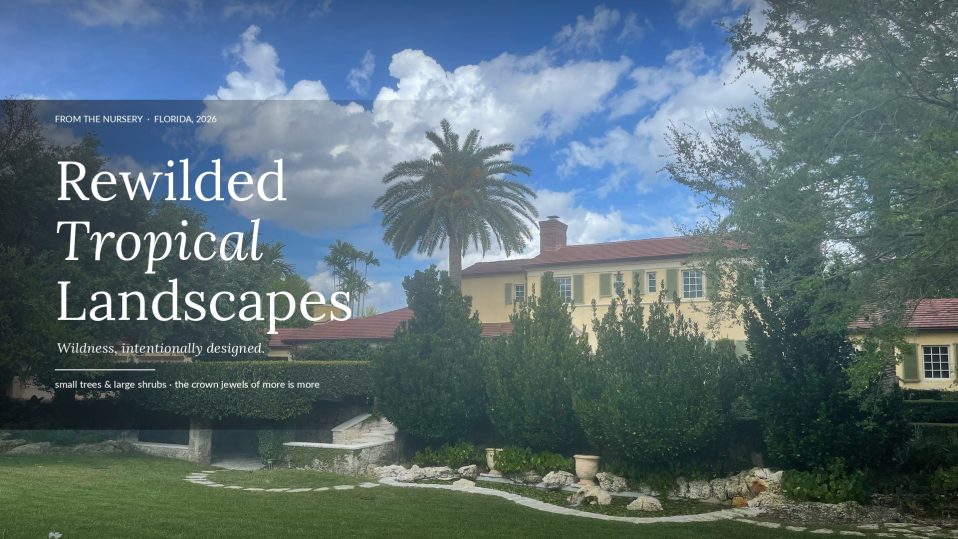
Rewilded tropical landscapes? At first glance, rewilding sounds like letting a space go wild. But in landscape design—especially in Florida—it means something more intentional: creating layered, self‑sustaining spaces that read as natural while still being controlled. Welcome to a guide to Rewilded Tropical Landscapes that balance wildness with intentional design.
Key Takeaways
- Florida garden design is shifting to rewilded tropical landscapes—a lush, layered maximalism inspired by the Regencycore style.
- The secret to this look is using mid-layer small trees and tropical hedges to build deep, textural compositions.
- The design relies on specific structural plants: Madagascar Olive (for rhythm), Garcinia spicata (for green mass), and native Jamaican Caper (for breathability).
- These self-sustaining gardens use climate-resilient, low-maintenance plants that require selective pruning rather than strict, weekly shearing.
We’re shifting away from minimalism into an era where “more is more.” Garden design now favors meadow‑style compositions, freely flowing plants, and natural stone woven through beds. These shifts point directly to how Rewilded Tropical Landscapes are being imagined today.
The Regencycore Trend in Tropical Landscaping
You might be surprised to learn that the Regencycore trend (yes, thanks to Bridgerton) has influenced landscaping. Regencycore draws from the British Regency era—early 1800s—and translates in gardens to spaces that feel refined yet lush, structured but expressive.
Picture deep planting beds with multiple layers of texture — not the manicured restraint of mid-century minimalism, but compositions where every plant earns its place through what it adds: foliage color, branching habit, seasonal bloom. Borders read as full but never haphazard. Stone, gravel, and architectural elements anchor the planting rather than displacing it.
In Florida that translates differently than it does in an English country garden. We don’t have boxwood and lavender; we have the saturated greens of Garcinia, the rhythm of Madagascar Olive, and the airy structure of Jamaican Caper. The materials change but the principles hold — layered abundance, tonal harmony, structure expressed through plant character rather than imposed by shears. Rewilded Tropical Landscapes apply that Regency-era logic to a subtropical palette: dense, tonal, intentional.
Creating Abundance with Small Trees and Hedges
Before every landscape project comes the question: what will it look like? Opinions increasingly favor outdoor living spaces that feel “cozy,” filled with color and texture, where trees and hedges are consciously chosen to look like they belong. Abundance is not just the number of trees but the diversity of textures and how those textures play together to achieve harmony.
If you want to dive deeper into combining different species, read our guide on Mixed Hedges Ideas. And, of course all layers matter, but here we’ll focus on small trees and hedges — and how they build the sense of abundance.
Mastering Jewel Tones and Leaf Textures
At our nursery we lean into jewel tones that blend beautifully, multiple layers of green rather than flat single tones, foliage color as well as blooms, and—above all—lots of texture.
Why Every Layer Matters in Maximalist Garden Design
We’ve built our reputation on big trees, but we can’t neglect the spotlight of small trees and large shrubs, which are increasingly in demand. These mid‑layer trees deliver quick structure, texture, and seasonal interest—perfect for clients who want faster impact or denser, more intimate plantings without waiting years for large trees to mature.
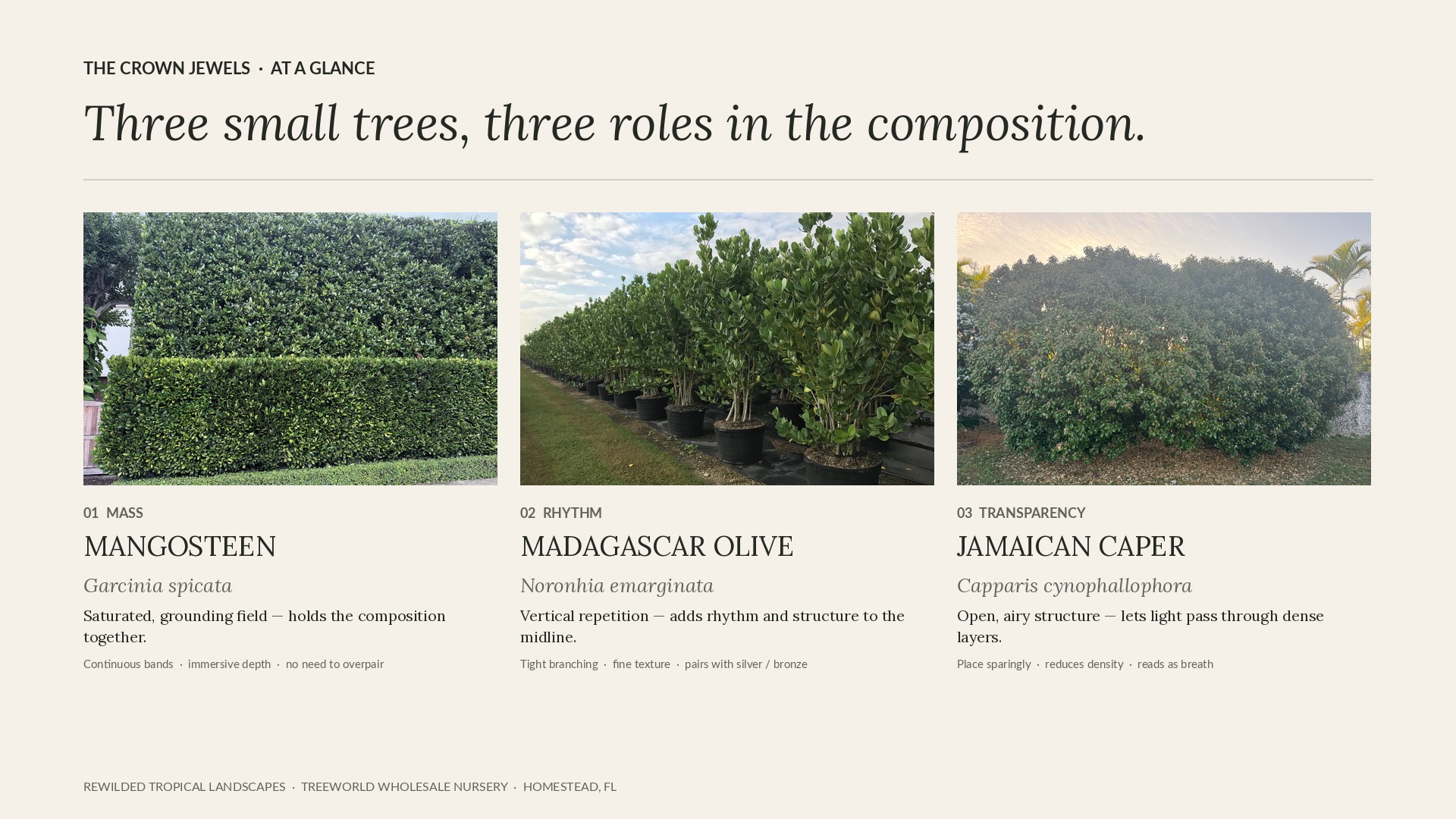
Our crown jewels for this “more is more” era.
Plant choices drive Rewilded Tropical Landscapes — here’s how small trees and hedges do the work.
Noronhia emarginata (Madagascar olive) – The Mid-Layer Anchor
Noronhia emarginata is essential to Rewilded Tropical Landscapes as a midlayer anchor. Also known as Noronhia emarginata (common name Madagascar olive), it’s what we like to call a composition plant. It features clean, deep‑green foliage that holds color year‑round and a fine texture that contrasts well with bold leaves like Clusia rosea. Its tight branching creates structure without looking rigid, and its upright habit is perfect for adding vertical rhythm to the lower layers. It naturally forms dense hedges and screening walls, making it a top choice for privacy landscaping and salt-tolerant coastal designs.
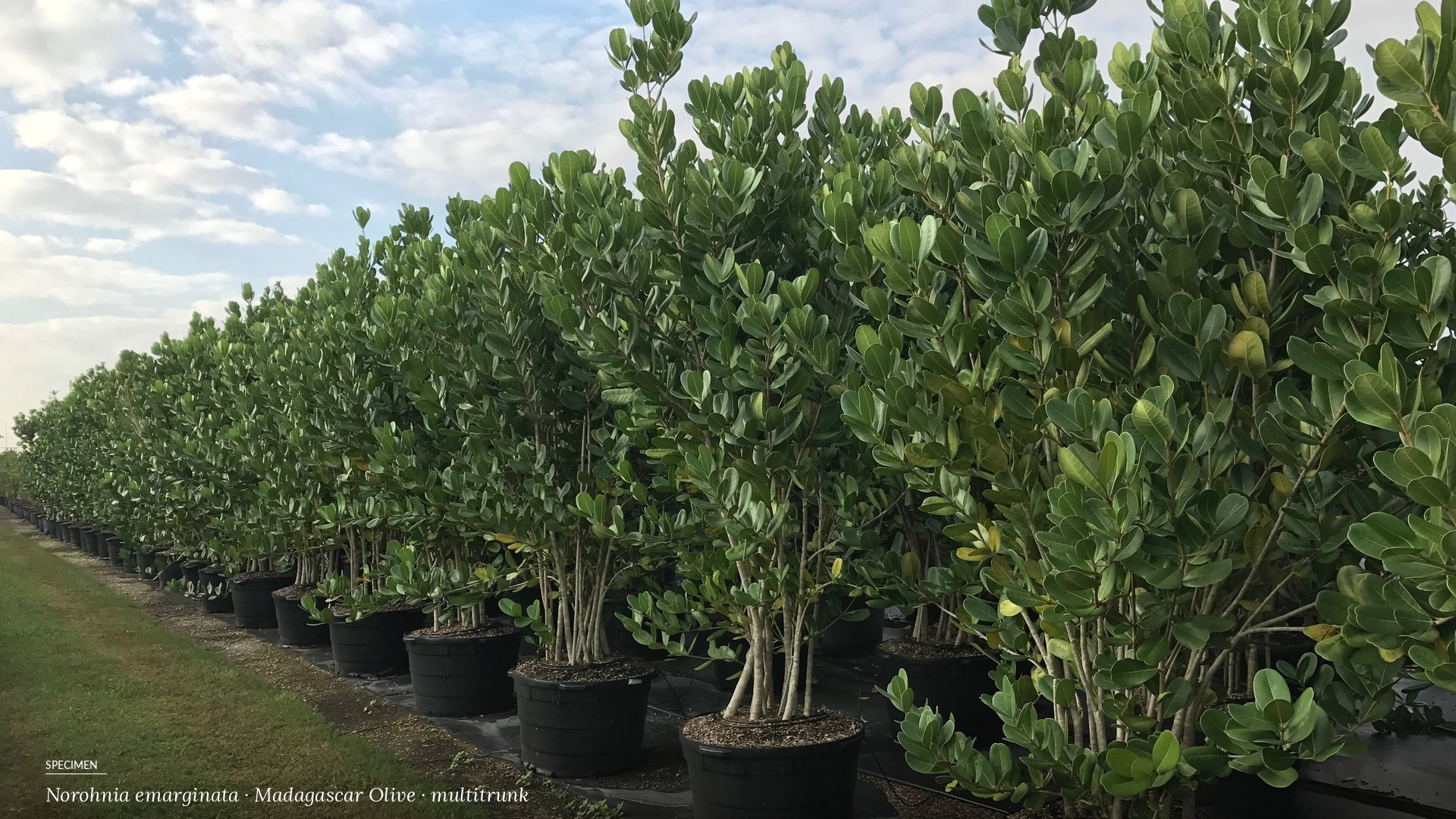
It reinforces the idea of maximalism through abundance, texture, color contrast, and layered repetition. Plant Madagascar olive in groups rather than as single specimens to create instant density and rhythm. Use it as a repeating midline between taller trees and low groundcovers to visually thicken the middle layer and build multi‑tiered depth.
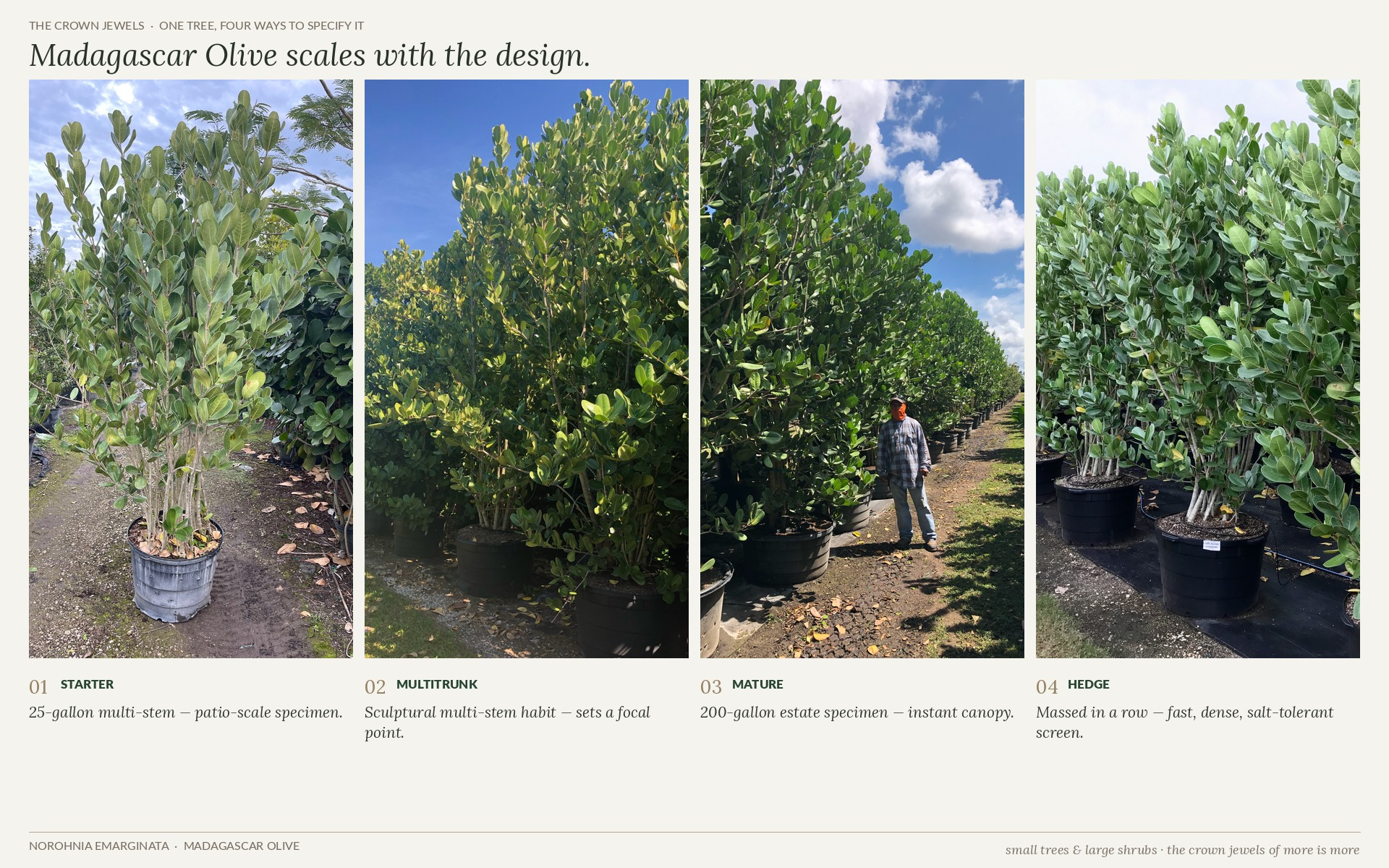
For contrast and color, pair the glossy green foliage of Noronhia with companions such as Silver buttonwood (Conocarpus erectus var. sericeus) for silvery contrast and textural lightness, or Satinleaf (Chrysophyllum oliviforme) for a bronze‑gold underside that adds jewel‑toned warmth and dense massing. This creates complexity without relying on exotic additions. The repetition and rhythm of Noronhia with Silver buttonwood or Satinleaf in drifts builds that intentional “more‑is‑more” density.
Garcinia spicata – The Grounding Field
When used in Rewilded Tropical Landscapes, Garcinia gives the midlayer a saturated, grounding field. Also known for its rich tropical character, Garcinia spicata stands apart as a composition plant with presence. Its foliage is not just green — it’s deep, saturated, and vivid, holding its color year‑round with a density that immediately draws the eye. The leaves are thicker, smoother, and more substantial, giving the plant a visual weight that feels grounded and confident —an essential trait for maximalist garden design.
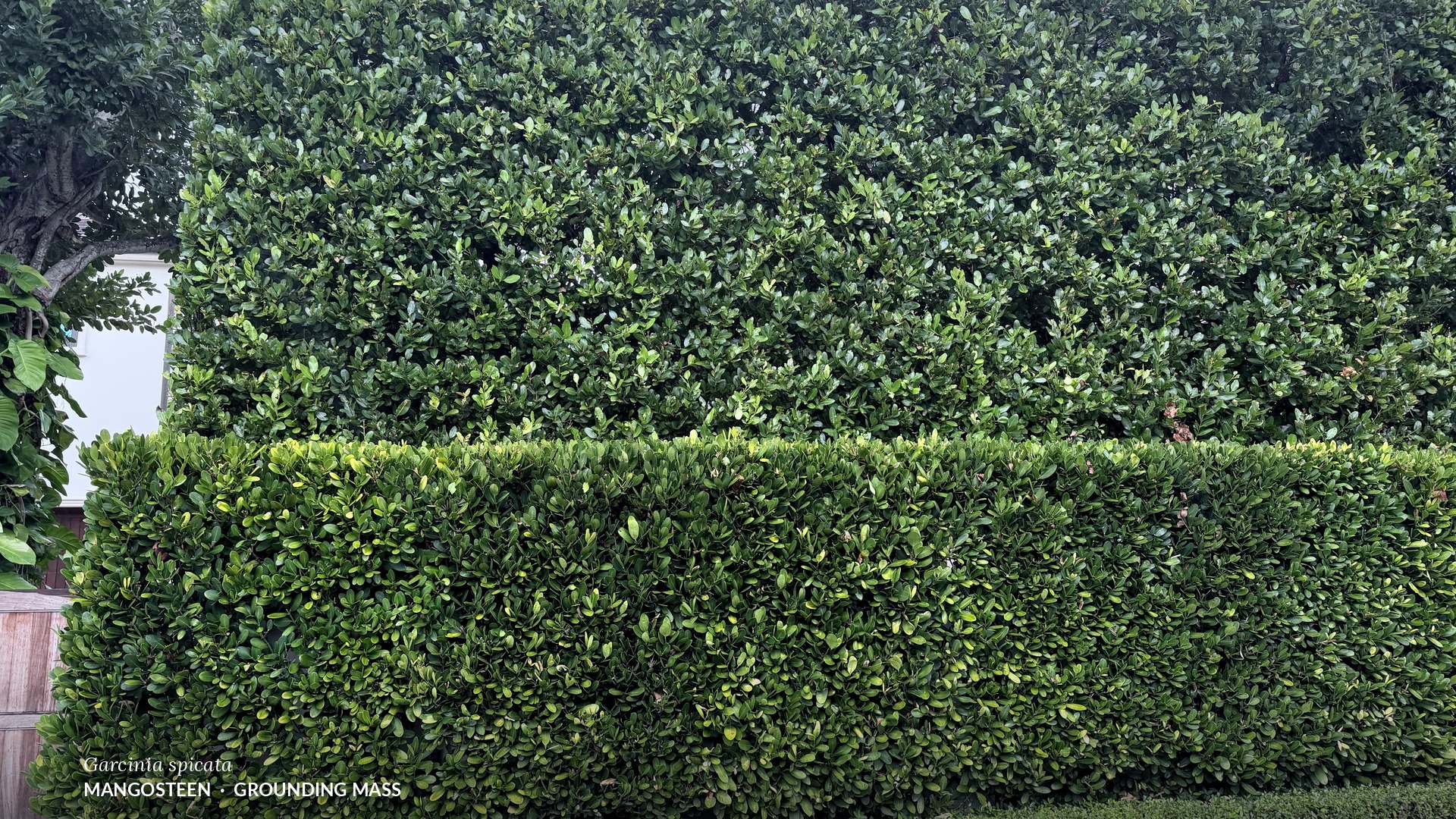
Its growth habit reinforces that presence. Naturally compact and upright, Garcinia builds volume without needing to be shaped. It creates structure, but in a quieter, fuller way than Noronhia. Where Noronhia introduces lightness and rhythm, Garcinia delivers mass and saturation.
It supports a maximalist approach through depth and repetition rather than contrast. Plant Garcinia in groups to form continuous bands of green. This creates a strong visual anchor in the mid and lower layers. Instead of breaking the composition, it holds it together.
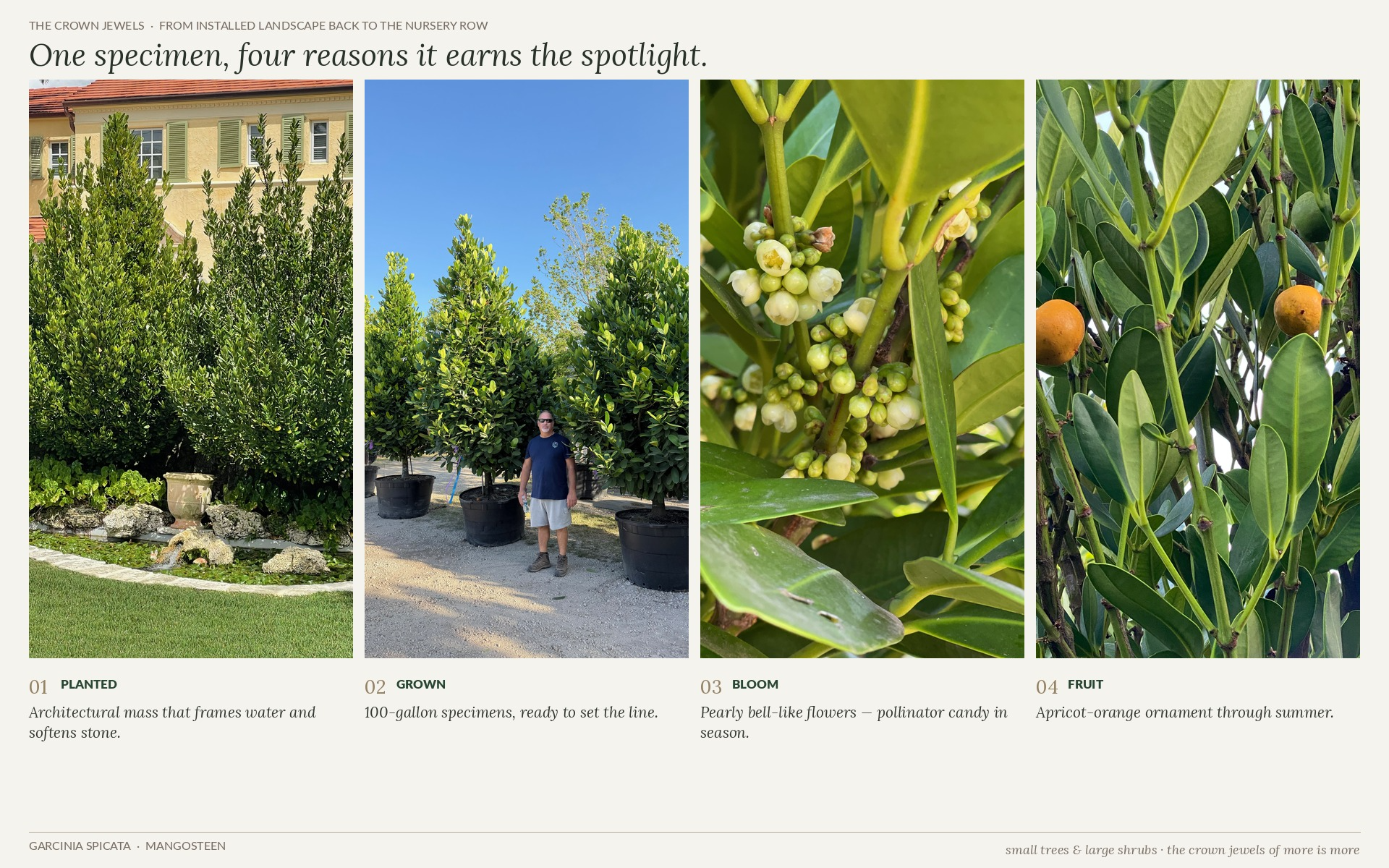 There’s no need to overpair it. In fact, restraint makes it stronger. Let Garcinia carry the composition on its own — its hue is rich enough to stand without interruption, creating a field of color that feels immersive rather than busy. Use it as a grounding layer beneath taller trees or as a standalone mass that defines space. Maximalism is not about adding more elements; it’s about allowing one element to fully express itself.
Capparis cynophallophora (Jamaican caper) – The Breathable Layer
Jamaican caper adds breathable moments that are key to successful Rewilded Tropical Landscapes. Also known as Jamaican caper, it functions as a breathing midlayer within the composition. It features an open, airy branching structure and lighter foliage that lets light pass through. Its presence is subtle, but intentional.
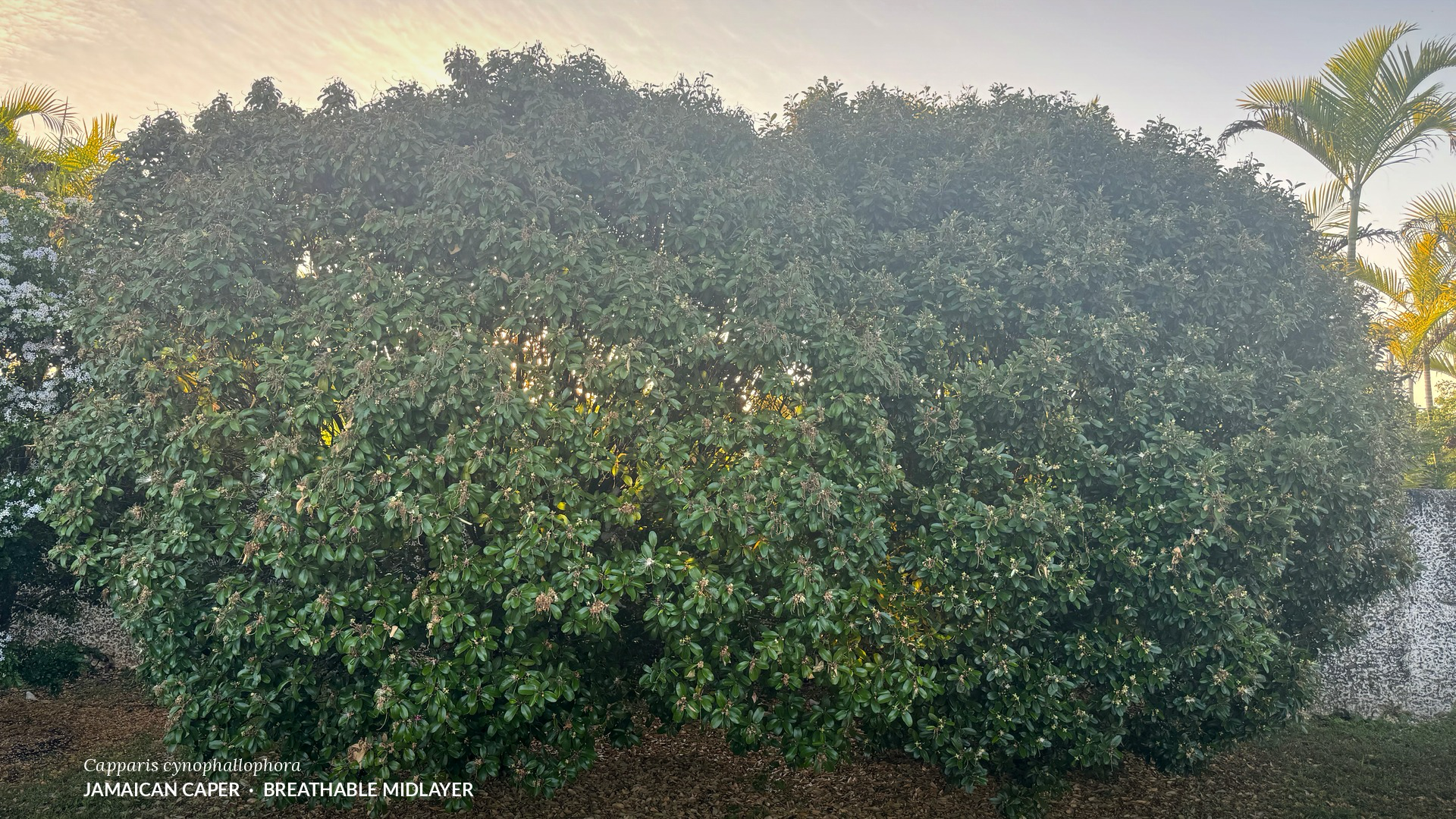
One more reason it earns its place: Jamaican caper is a Florida native and the larval host for the Florida White butterfly (Appias drusilla), with dusk-blooming flowers that feed bees, moths, and hummingbirds.
Its growth habit introduces variation without disrupting structure. It does not build mass like Garcinia, nor does it create rhythm like Noronhia. Instead, it reduces perceived density. This makes it essential in compositions where layers begin to feel too continuous or visually heavy.
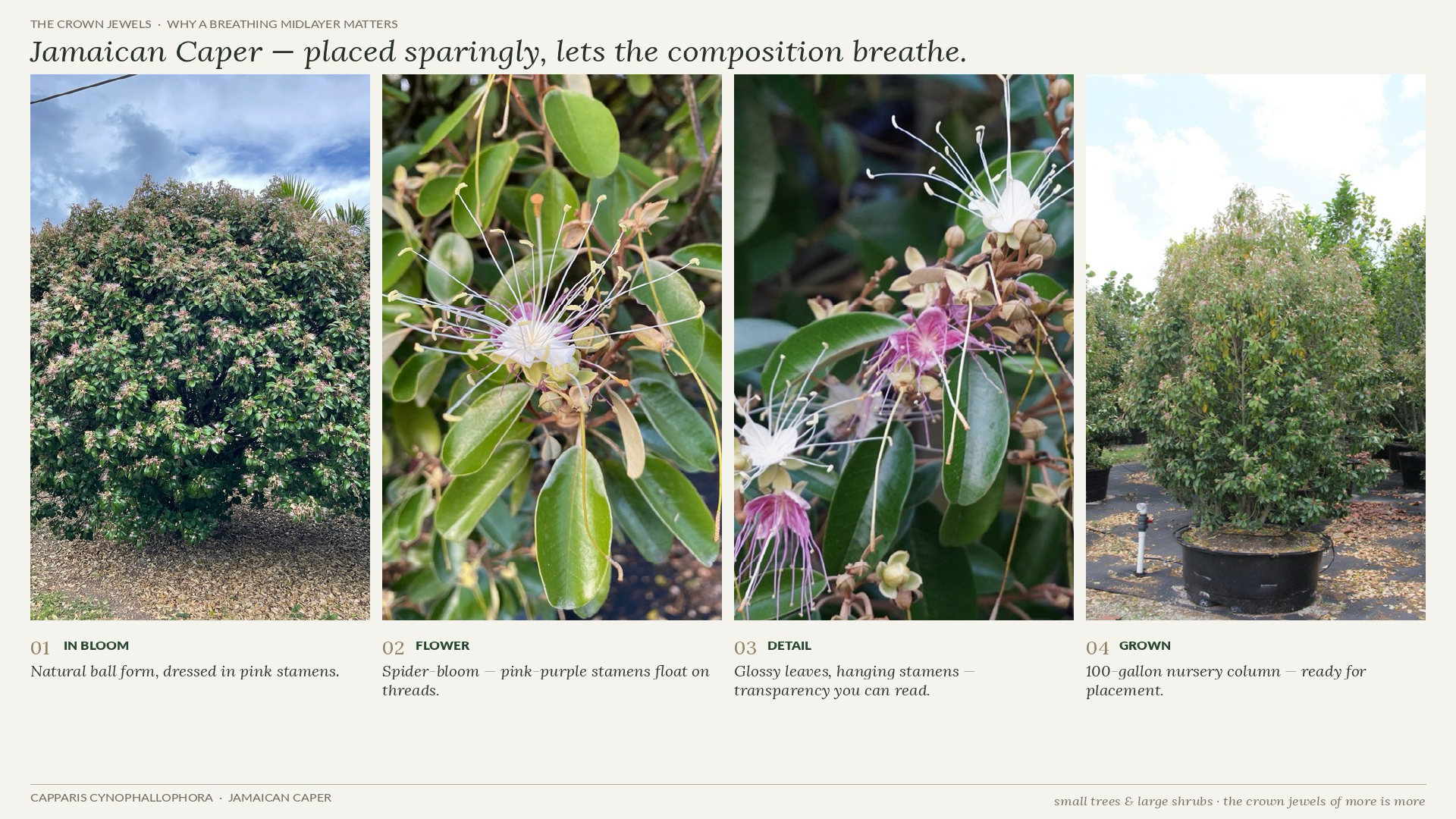
It supports a maximalist approach through contrast in structure rather than color. Use Jamaican caper sparingly, placing it between denser groupings to create moments of transparency. That lets background layers remain visible and adds depth without adding complexity.
In compositions where Garcinia builds mass and Noronhia establishes rhythm, Jamaican caper interrupts that continuity. It softens repetition, lets light pass through, and creates layers you can actually read. The result is a composition that feels dynamic, balanced, and intentional.
Ready to bring a Rewilded Tropical Landscape to life?
Are you ready to design your own rewilded tropical landscape? Book a site visit or consultation with our experts today.
- Call us: 305-245-6886,
- Email: info@treeworldwholesale.com,
- Visit our nursery: 24605 SW 192 Ave, Homestead, FL 33031.
We’re open 8–5 Monday–Friday and available weekends by appointment
FAQ – Frequently Asked Questions About Rewilded Landscapes
What is the difference between a rewilded garden and an overgrown one?
An overgrown garden lacks design and allows invasive species to take over. A rewilded landscape is highly intentional; it uses carefully selected plants structured in layers to mimic nature while remaining fully under the homeowner’s control.
Can I achieve a maximalist look in a small Florida yard?
Absolutely. In smaller spaces, mid-layer plants like the Madagascar olive and Garcinia are perfect. They provide the dense, lush feeling of a tropical canopy without the massive footprint of a large shade tree.
Do rewilded tropical landscapes attract pests?
Rather than pests, these layered ecosystems are designed to attract beneficial wildlife. By incorporating natives like the Jamaican caper, you invite pollinators and birds which naturally help keep pest populations in check.