
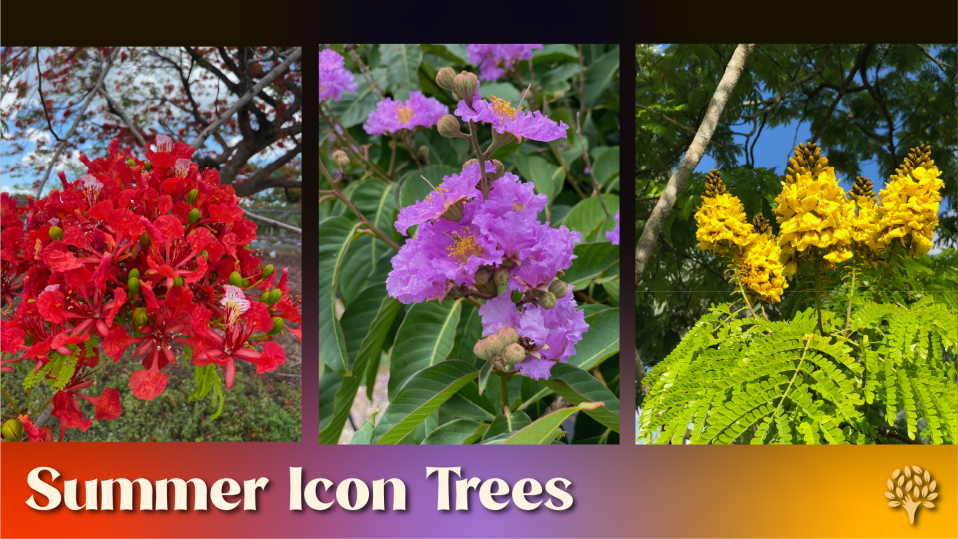
Summer trees feel like a funny concept, even for Florida. But we must say they are true parts of what makes Florida summers so iconic. You know this time of the year because it’s hot and humid from the moment you step outside. Temperatures sit in the low-to-mid 90s daily, but the heat index is closer to 100+. Everyday pace slows down, as people move between air conditioning and the outdoors in short bursts. Early mornings are sacred, becoming for most the only truly comfortable outdoor time before the heat builds. Not our case in TreeWorld but we understand.
And of course afternoons with a daily dose of thunderstorms. Because like clockwork, around 3-4pm the sky turns that bruised purple-green, the air pressure drops, and then it absolutely pours. Thirty minutes later the sun is back out and everything is steaming. A cycle that becomes the heartbeat of the season.
Everything is aggressively alive. The greens are deep and saturated, almost jungle-like. The air smells like wet earth, jasmine, and salt depending on where you are.
Flowers are at their most extravagant. And it’s precisely this heat, this humidity, this daily drama — that these trees were made for. Not silent, and definitely not shy, summer flowering trees love the attention. They burst and thrive for the season becoming true Florida Icons.
Key Takeaways:
- Royal Poinciana (Delonix regia) is Florida’s most iconic summer tree, erupting in flame orange-red from May through July – wet summer air makes the blooms appear almost luminescent.
- The Key West Red is a distinct true-red variation of the standard Royal Poinciana, subtle to the untrained eye but unmistakable to those who know.
- Queen Crape Myrtle (Lagerstroemia speciosa) is one of the few trees that actually requires subtropical heat – Zone 10 is not a compromise, it’s a requirement.
- The Copperpod (Peltophorum pterocarpum) is South Florida’s most underappreciated summer tree – drought tolerant, salt tolerant, fast growing, and one of the few that blooms twice a season.
- All three trees arrived from different continents – Madagascar, the Indian Subcontinent, and Southeast Asia – and found in South Florida exactly the conditions they needed to thrive.
Florida’s Most Iconic Summer Flowering – Delonix regia
If Florida has a summer signature tree, this is it. The Royal Poinciana (Delonix regia) doesn’t ease into the season — it ignites it. By late May its canopy erupts in flame orange-red, spreading wide and low like a canopy of fire against the sky. We track its blooming the way northerners track fall foliage. When the Poinciana is on, everyone notices. Royalty after all — we couldn’t expect less.
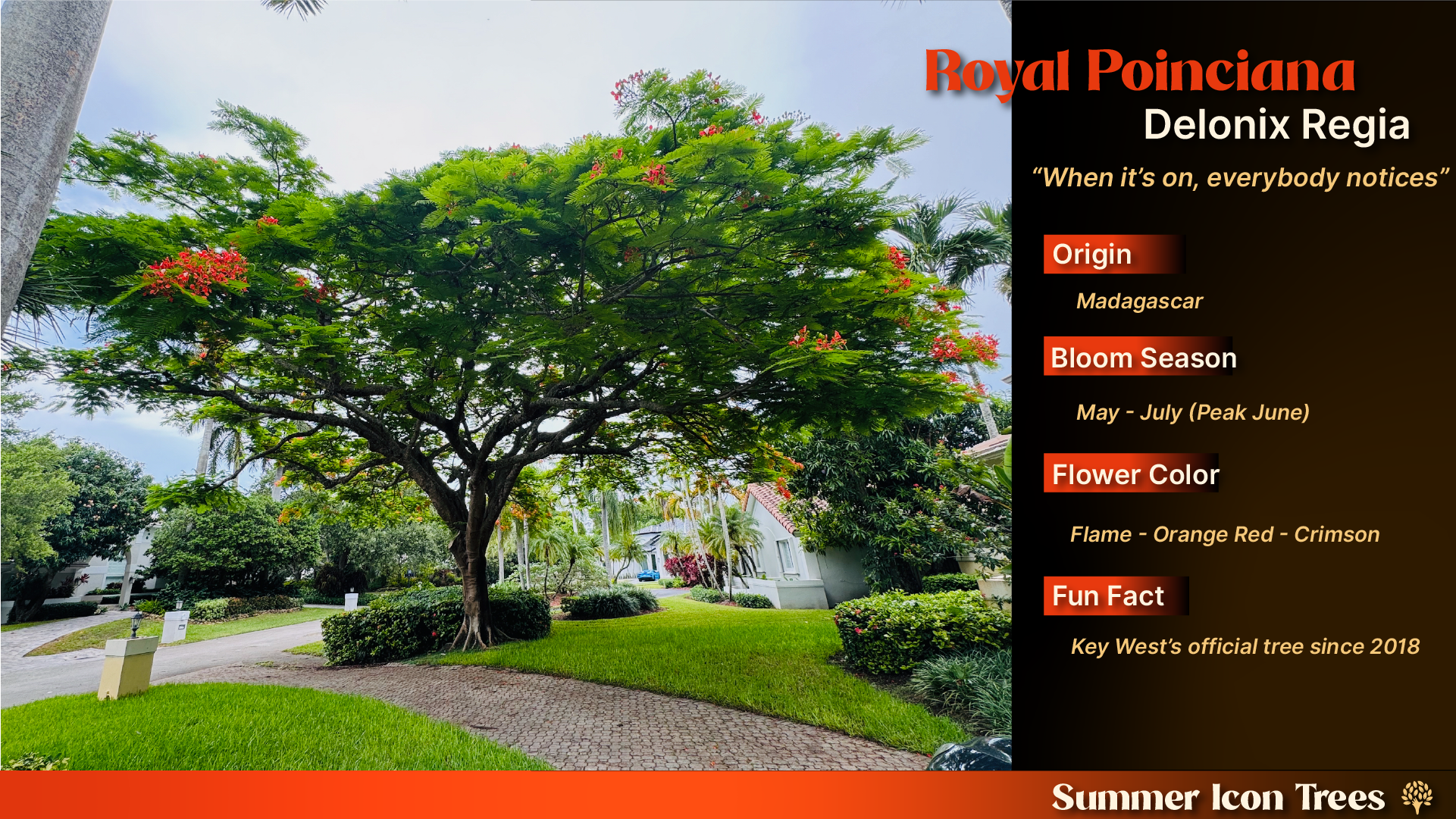
Truly one of the rewards for bearing a Florida summer is seeing these trees in full bloom — a giant umbrella of stunning, shocking deep red, crimson flowers. A common street tree, yes, but one with history and secrets.
About a century ago, David Fairchild encouraged the introduction of the flame tree to Miami’s landscaping and public areas. He was on to something. His wife Marian is thought to have planted the one at their Miami residence, the Kampong, in 1917. At a century old, that tree has survived some tumultuous Florida weather — and it’s still performing every summer.
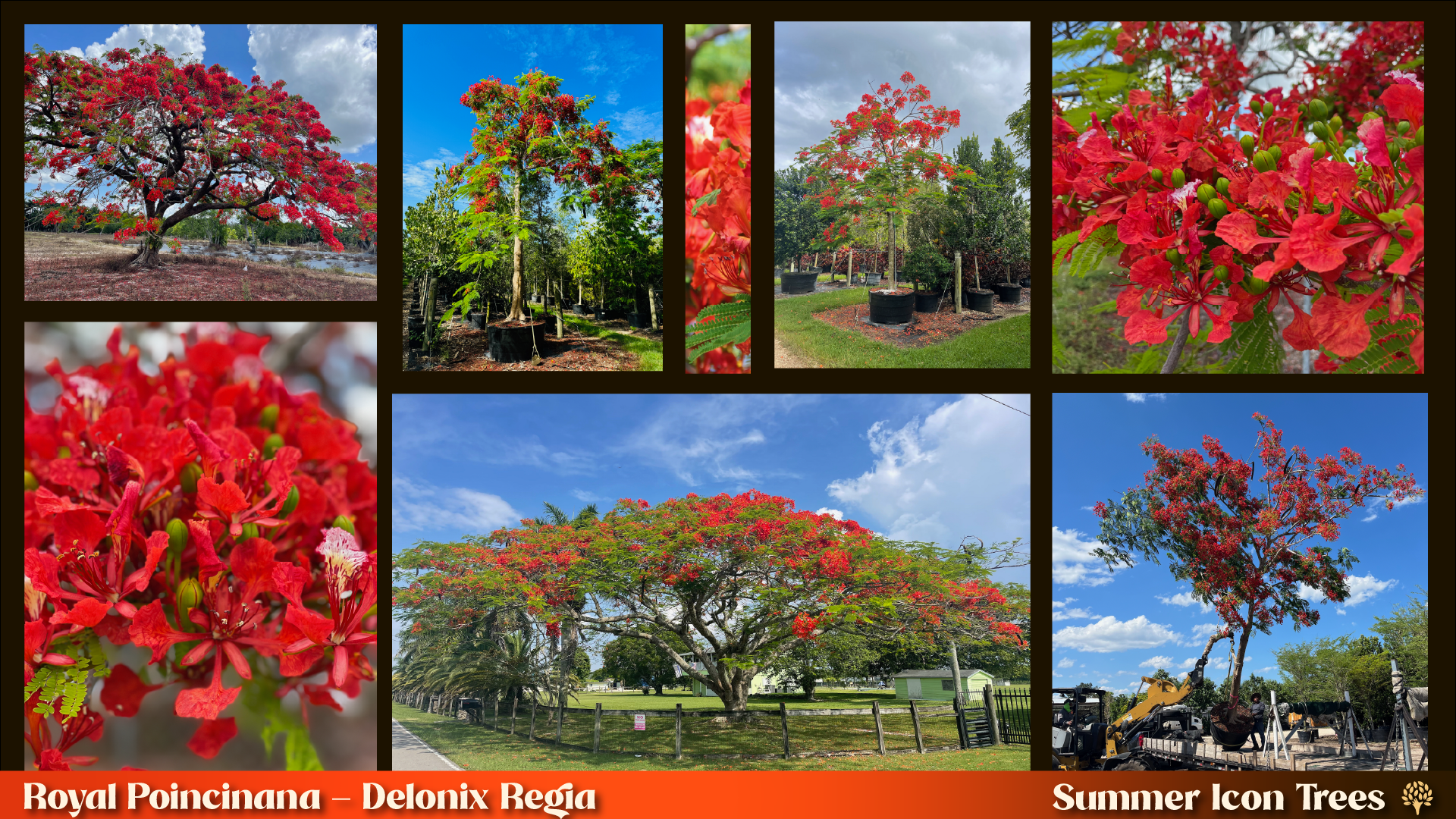
Native to Madagascar, it found its second home in South Florida and never looked back. It blooms June through July at peak, and the daily summer storms only intensify it. Wet air makes the orange almost luminescent, and after rain the fallen blooms carpet the ground beneath it in flame. The tree performs above and below.
From Miami to Key West: Florida’s Summer Icons
Along the corridor from Miami to Key West the story deepens. Key West claimed the Royal Poinciana as its official tree in 2018 — a designation that surprised no one. Every late spring it transforms the island into a vibrant tropical postcard, that fiery red-orange canopy becoming as synonymous with Key West as the sunsets.
And then there’s the Key West Red variation — a vibrant, true red that sets itself apart from the classic strawberry red of the standard Poinciana. Subtle to some, unmistakable to those who know. Same tree, different fire.
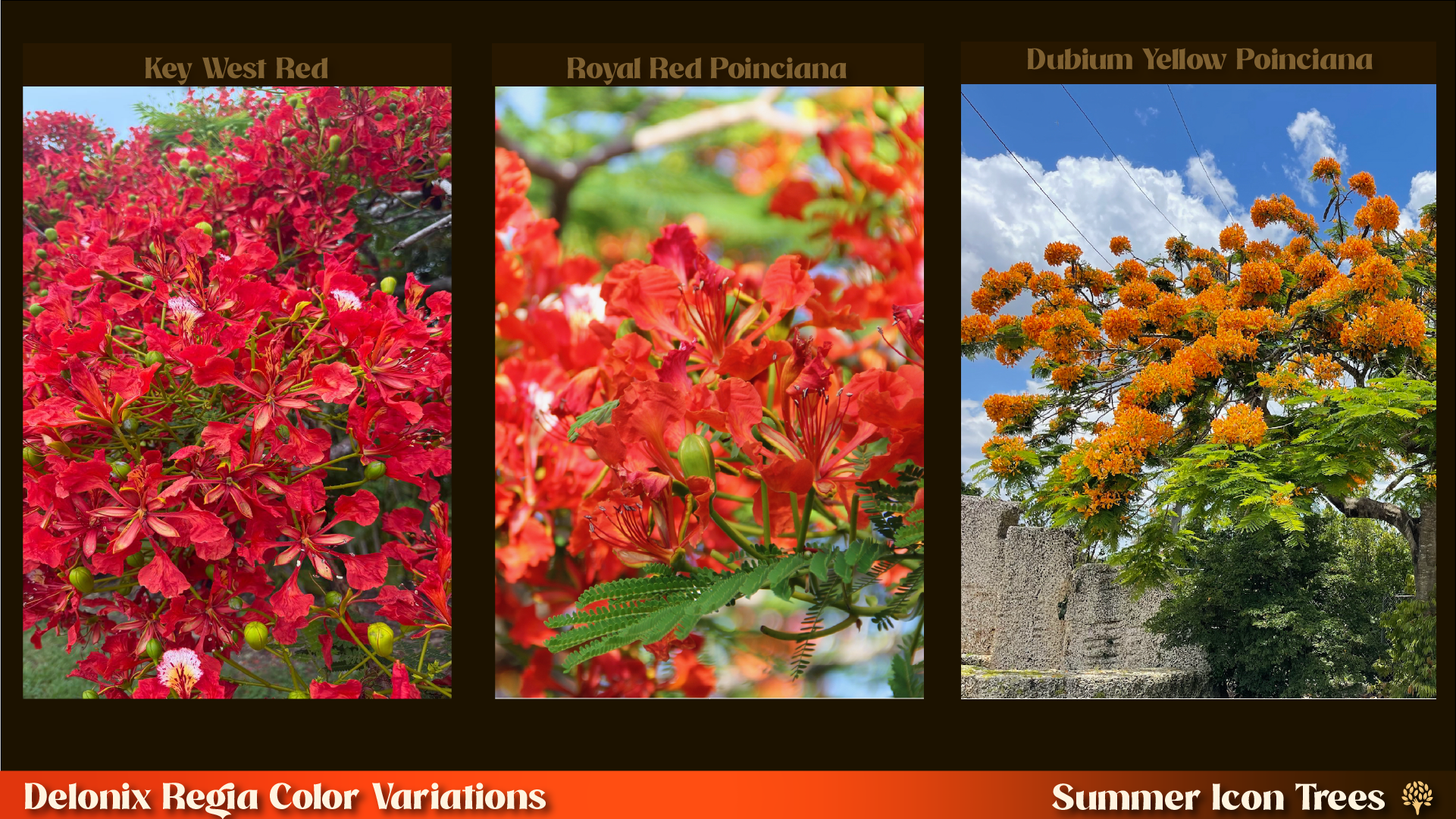
The Yellow Poinciana is so striking we don’t have enough words for its dramatic golden canopy — it surprises you precisely because you expected fire and got a kiss of sunlight instead. Same season, same Florida sky, three completely different tones.
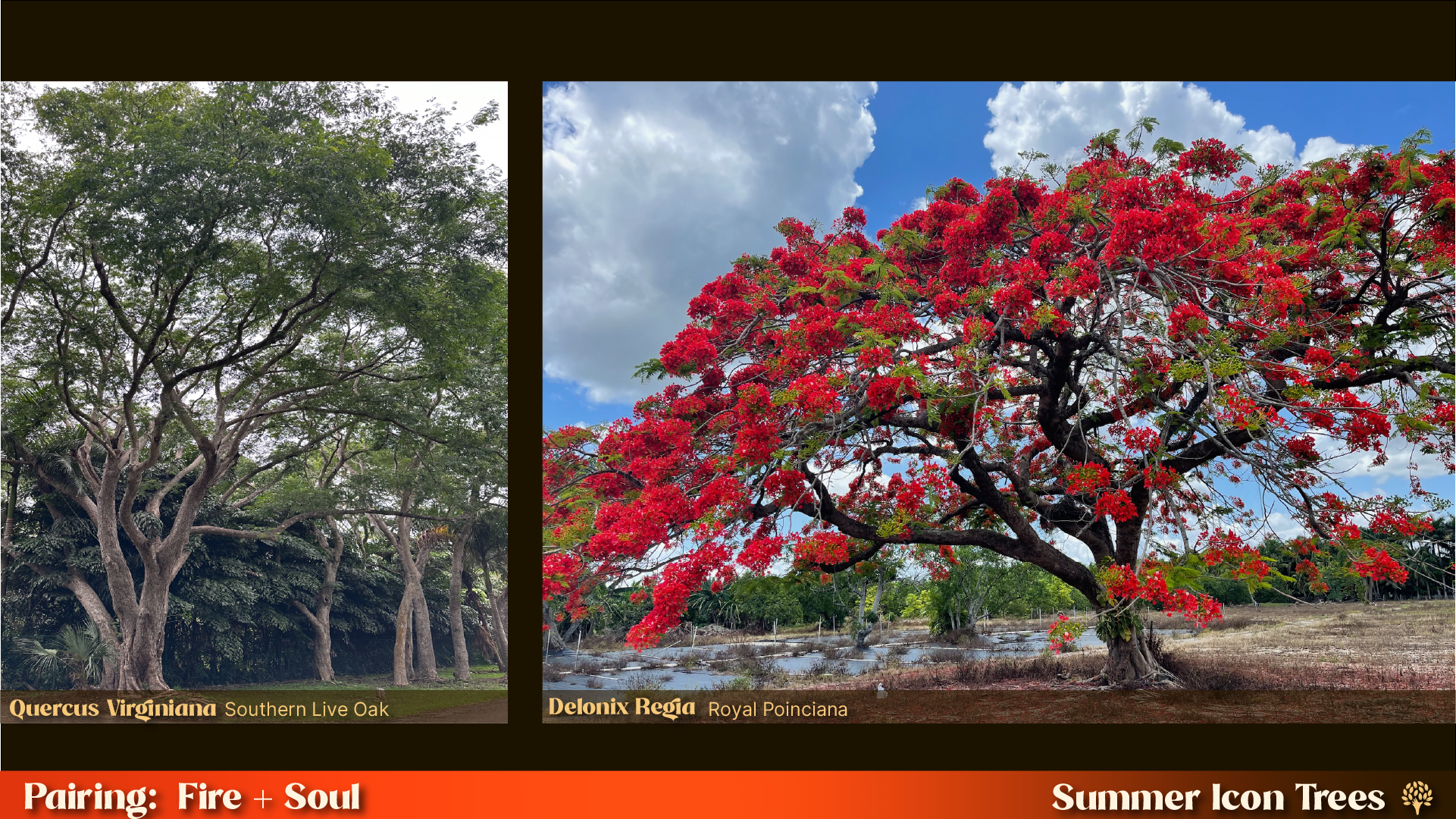
At TreeWorld we carry Royal Poinciana in varying sizes. Because some things shouldn’t wait. And if you’d like to pair it with some Florida green architecture, picture it alongside a Live Oak draped in Spanish moss — two Floridas in one frame: the tropical fire of the new world and the slow, moody soul of the old South.
Summer’s Alluring Queen – Lagerstroemia speciosa
Royalty doesn’t always announce itself. The Queen Crape Myrtle (Lagerstroemia speciosa) captures every eye in the landscape without ever raising its voice. Where the Poinciana ignites, the Queen Crape allures — delicate, whimsical, and quietly impossible to ignore. Native to the Indian subcontinent, South Florida’s subtropical climate is exactly what she needs.
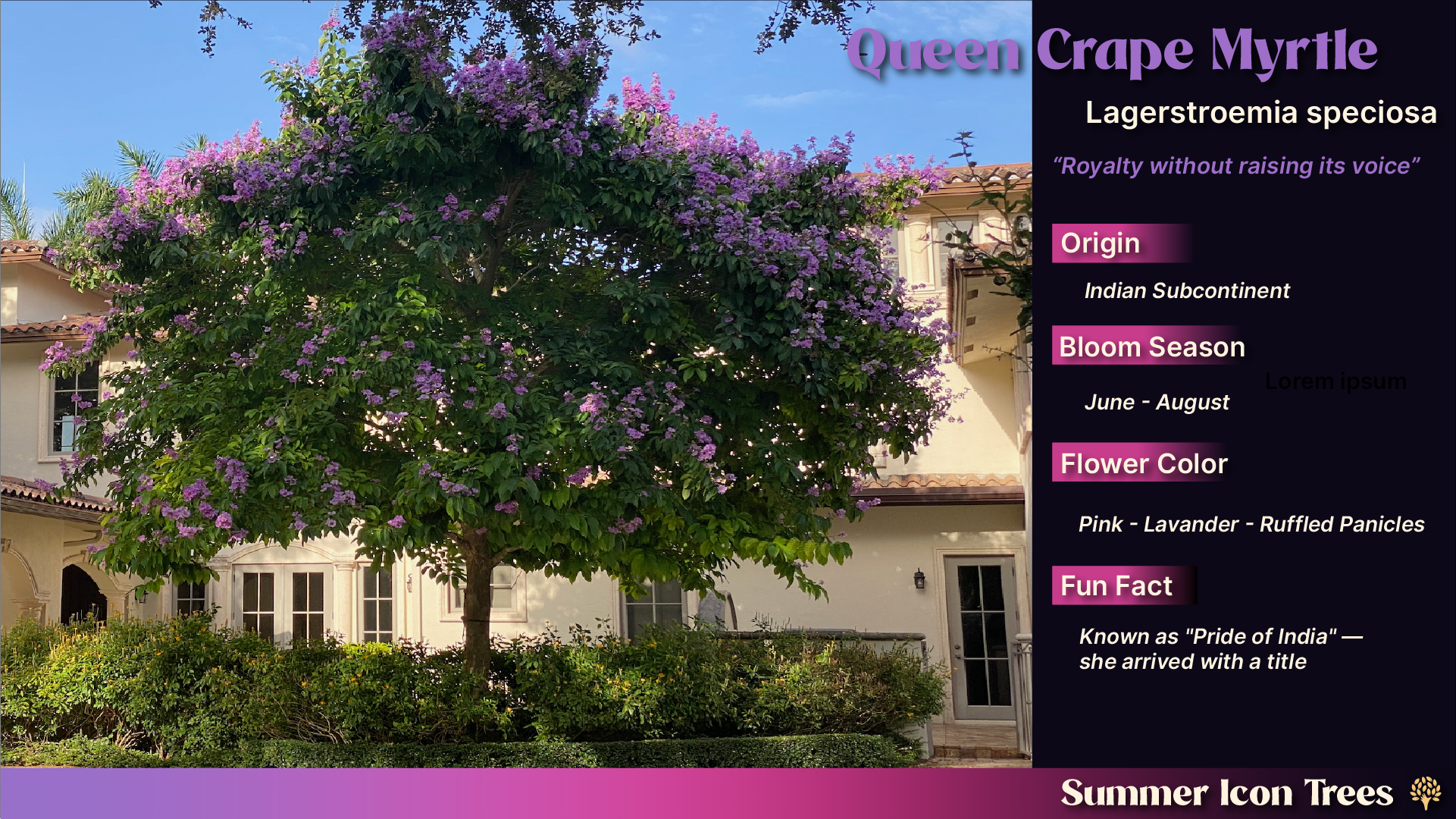
While most crape myrtles thrive in cooler climates north of us, the Queen is different. She belongs here. Subtropical heat isn’t a compromise for this tree — it’s a requirement. Zone 10 is her kingdom, and South Florida is her court.
Delicate by nature, resilient by design
And she earns the title. Three-inch wide pink and lavender ruffled flowers bloom on panicles reaching one to two feet long, June through July. The leaves are generously sized, four to fourteen inches, turning red before dropping in winter — a rare and unexpected seasonal show for South Florida. The canopy reaches thirty feet with a similar spread, and perhaps most surprisingly for a tree this beautiful, she’s remarkably storm tolerant. Durable, wind-resistant wood beneath all that elegance. Proper pruning in her formative years rewards you with a structurally sound tree that handles whatever a Florida summer throws at it.
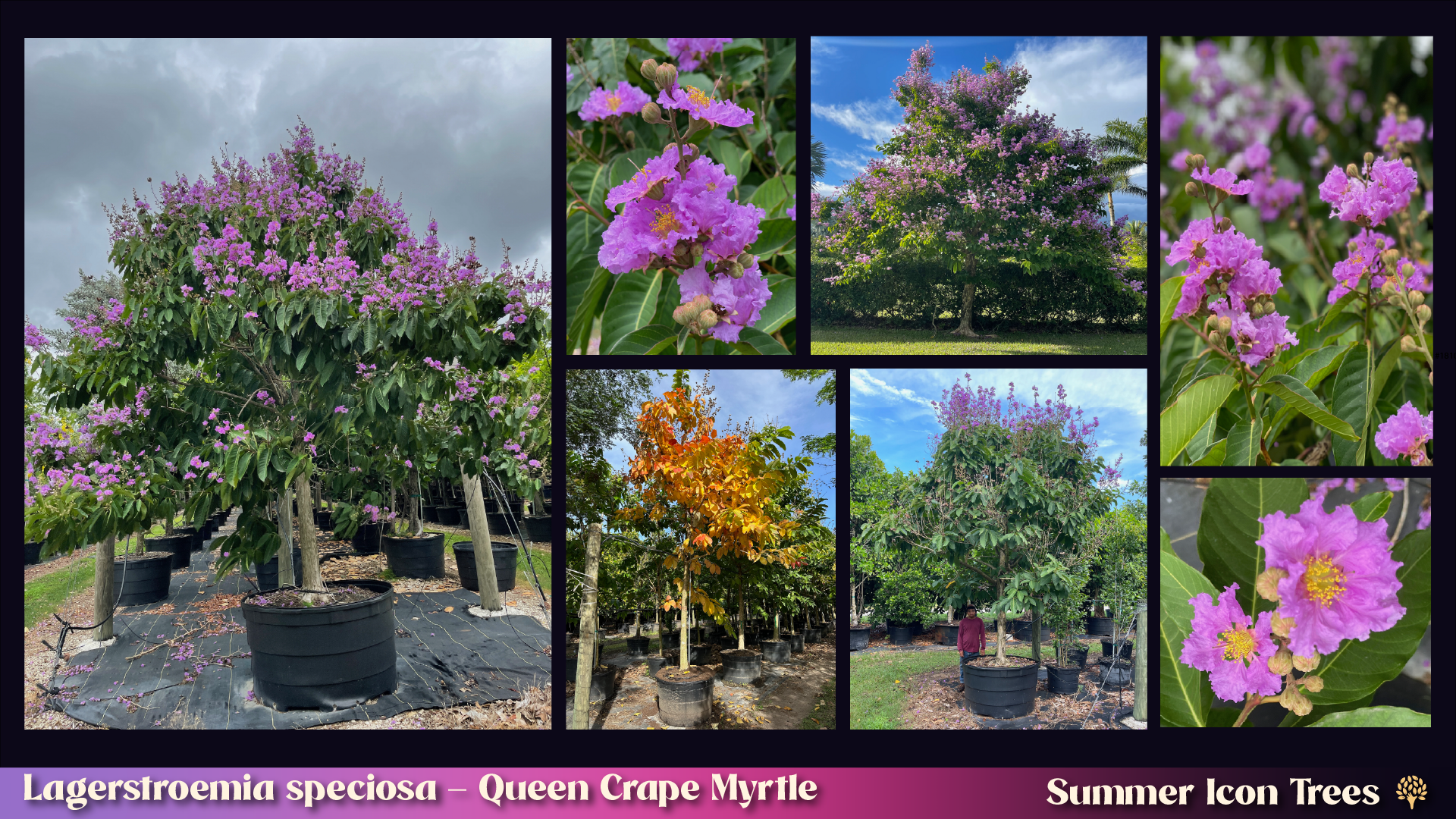
The further south and coastal you plant her, the better she performs. Proximity to water and recognized microclimates make a meaningful difference — though she’s only moderately salt-tolerant, so plan accordingly. Once established she’s highly drought-tolerant and rewards full sun with her most extravagant bloom.
The Queen Crape Myrtle belongs in the hands of those who know what they’re looking for. At TreeWorld, we do!
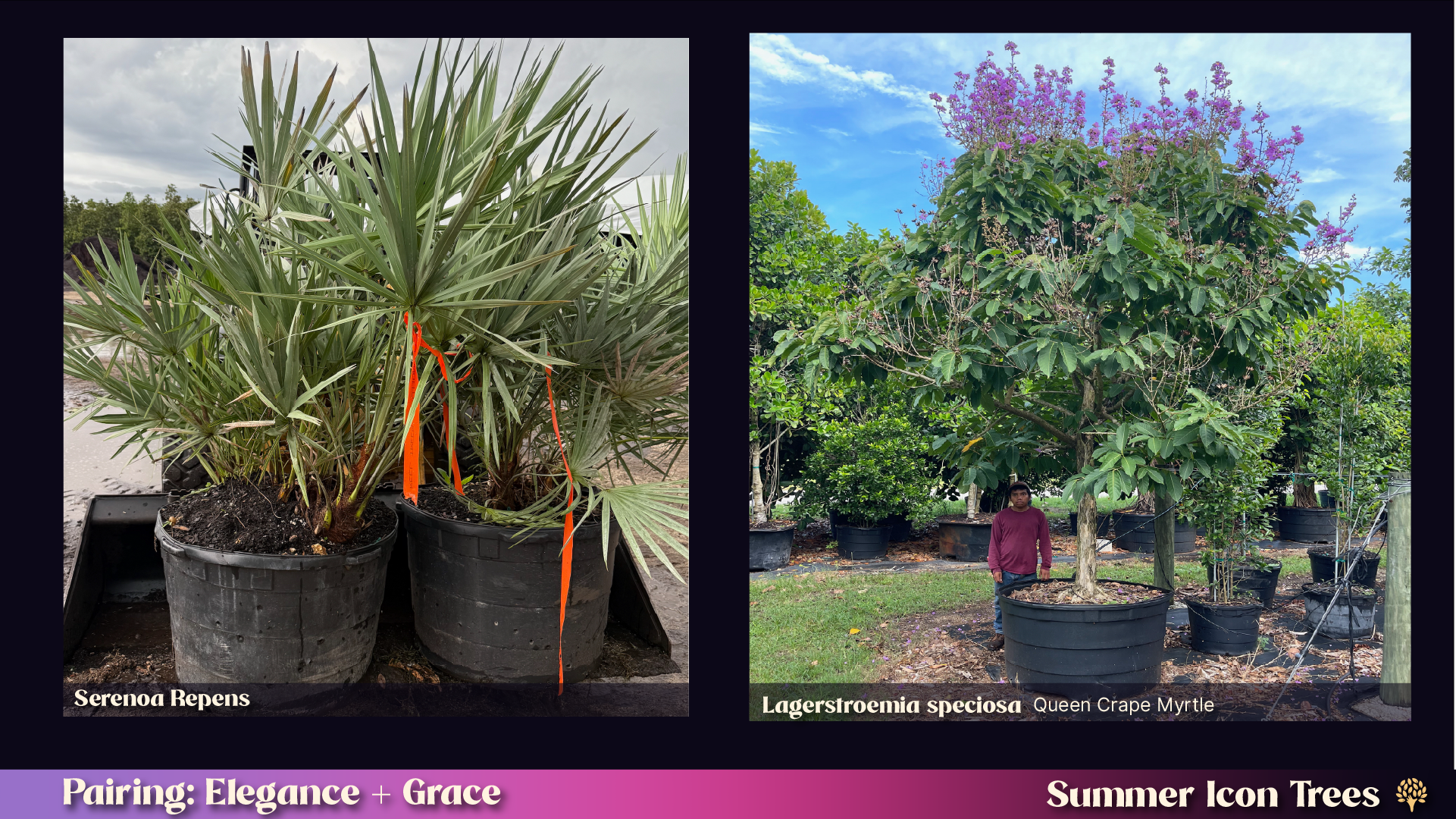
And if you’re thinking about pairing her with a Florida native? Absolutely, yes. The Sabal Palmetto, Florida’s state tree for sale, makes one of the most elegant combinations in the South Florida landscape. The Queen’s soft pink panicles against the clean vertical line of the state’s own tree. She belongs in this landscape the way the afternoon storm belongs to summer. Effortlessly, completely, as if it were always meant to be.
South Florida’s Most Underappreciated Summer Tree – Peltophorum pterocarpum
There’s a moment in a Florida summer when the light goes golden just before a storm and everything seems to glow. The Copperpod (Peltophorum pterocarpum) lives in that moment permanently.
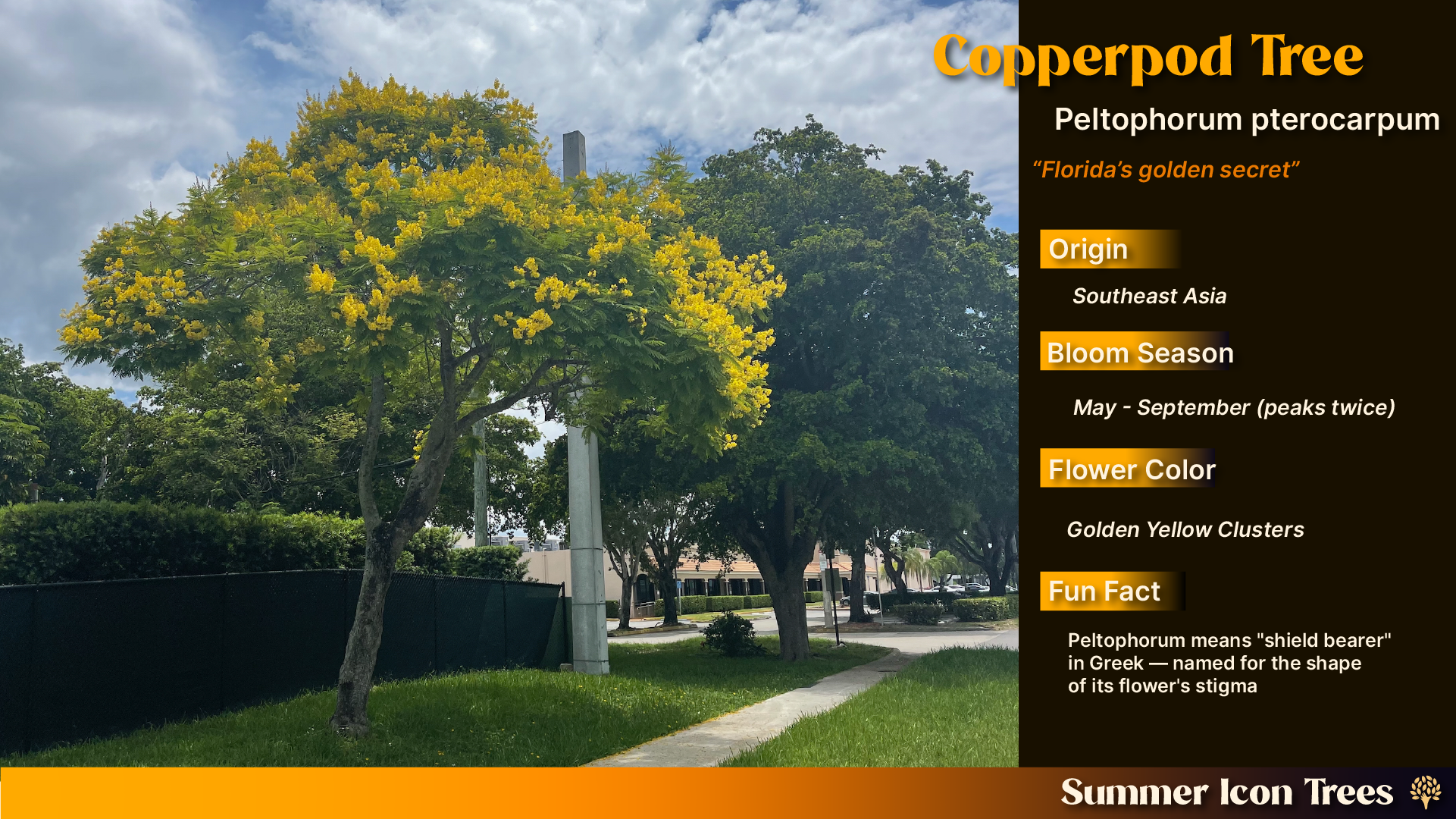
Also known as the Yellow Flame Tree, the Copperpod is South Florida’s most underappreciated summer tree. Native to Southeast Asia, it arrived quietly and took root with remarkable conviction. While the Royal Poinciana commands the street and the Queen Crape owns the garden, the Copperpod earns its place by simply being extraordinary when you least expect it.
Underappreciated, unforgettable
The canopy tells the story first — wide, umbrella-shaped, often as broad as it is tall, reaching forty feet with soft fern-like leaves that give it an almost delicate appearance. Then late spring arrives and the golden blooms ignite it. Upright clusters of fragrant yellow flowers, each one inch to one and a half inches wide, fill the canopy from May through September. Peak bloom hits June and July — right in the heart of the Florida summer drama — and unlike the others, the Copperpod often flushes twice, sometimes returning in fall as a quiet encore.
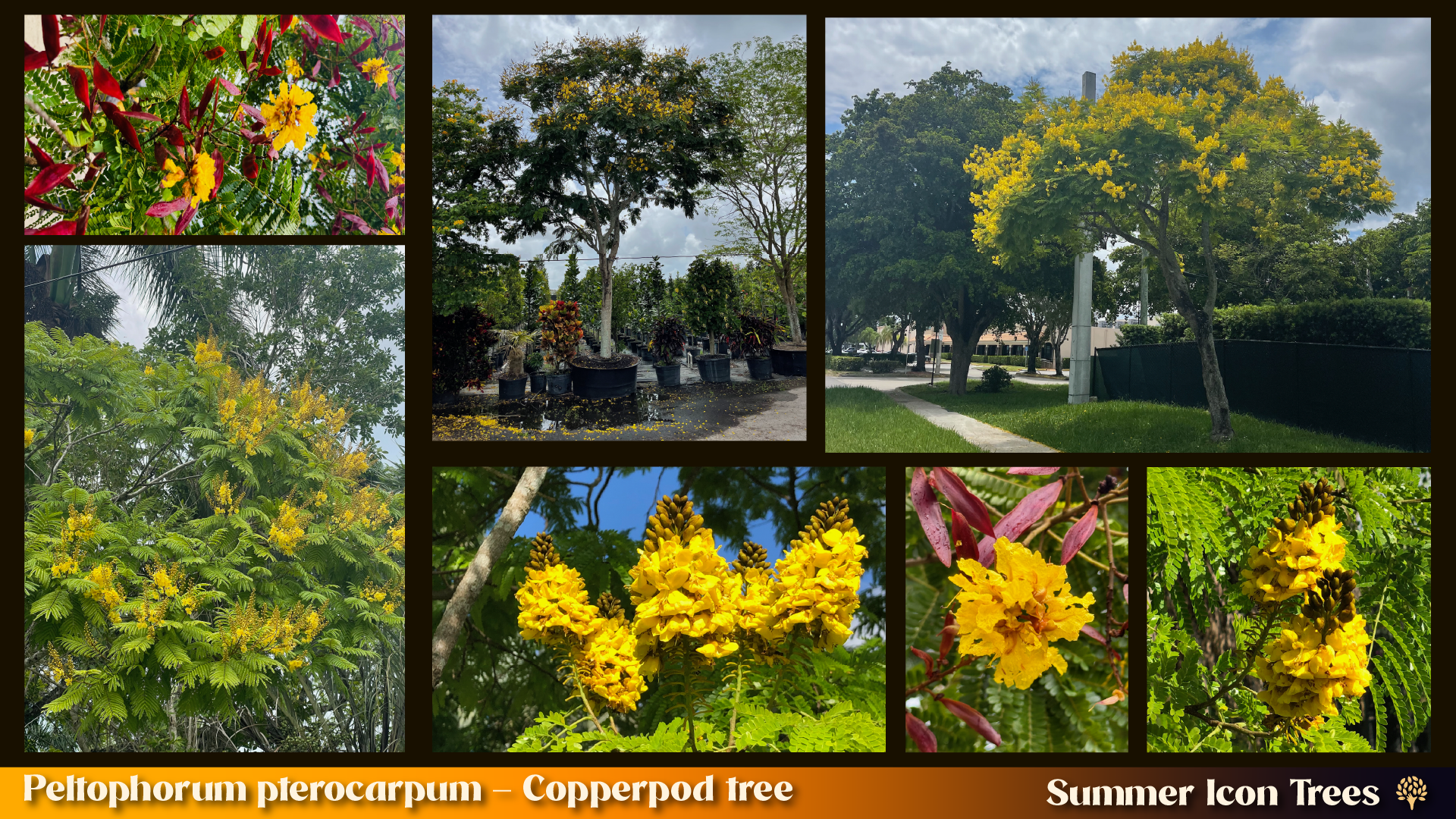
It’s also, practically speaking, one of the toughest trees in this lineup. Drought tolerant, salt tolerant, fast growing, and generous with shade — the kind of shade that actually cools a playground, a parking lot, a large backyard. Resort-feel landscaping without the resort price tag.
At TreeWorld we carry Copperpod because we believe the best trees aren’t always the most famous ones. Sometimes the discovery is the point!
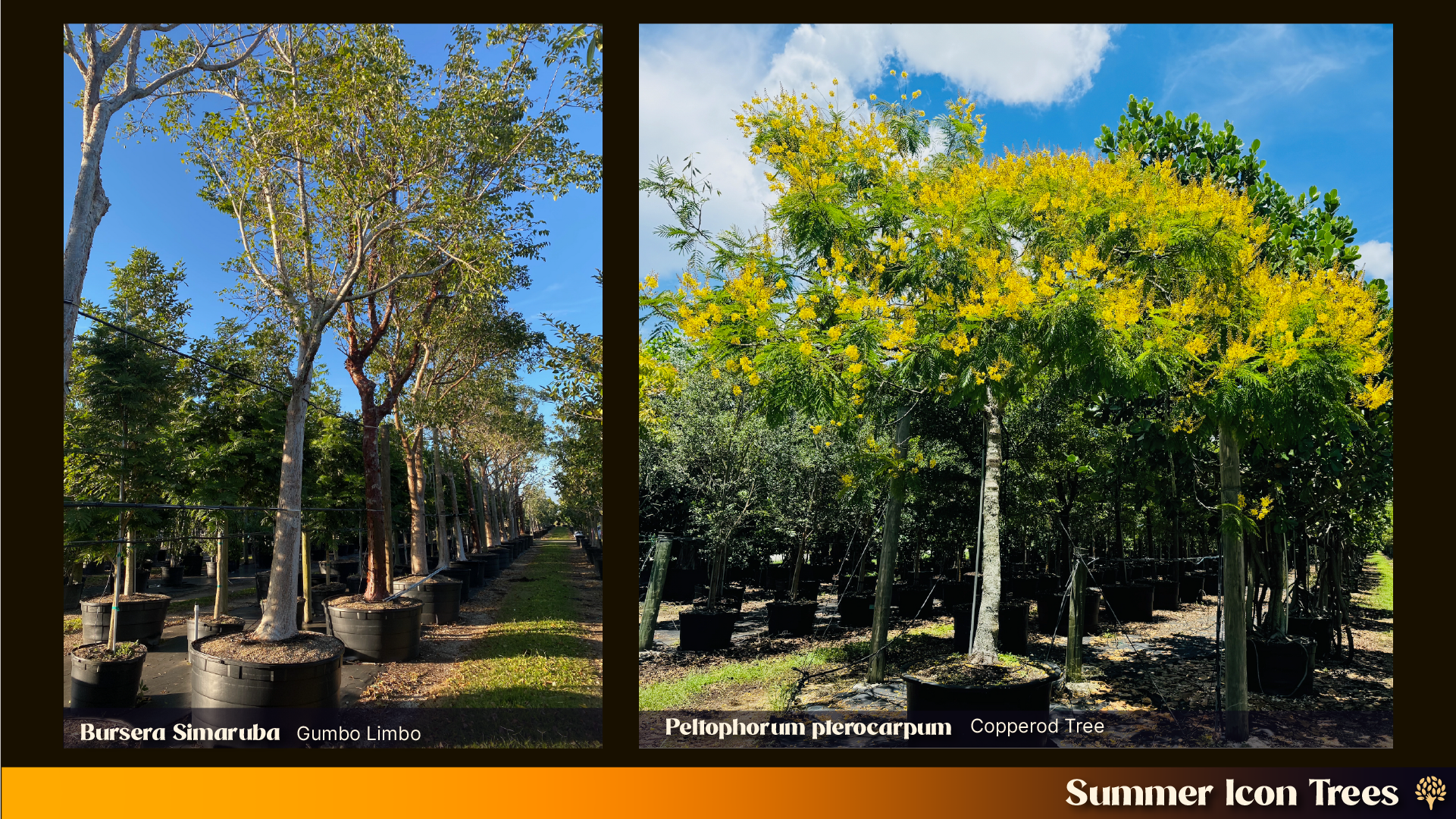
Pair it with a Gumbo Limbo nearby and you have one of the most distinctly South Florida compositions imaginable — the Copperpod’s golden canopy above the Gumbo Limbo’s peeling copper-red bark, warm and layered, two trees that feel like they’ve always belonged together.
Florida Summer, In Full Bloom
Summer trees feel like a funny concept — until you’ve stood under a Royal Poinciana in July, watched a Queen Crape push new blooms after every storm, or discovered a Copperpod glowing gold against a darkening Florida sky. Then they feel like the whole point.
These three trees don’t just survive a Florida summer. They claim it. Each one arrived from somewhere else — Madagascar, the Indian subcontinent, Southeast Asia — and found in South Florida exactly what they needed to become something extraordinary. Fire, elegance, and gold against a backdrop of bruised purple skies and steaming afternoon streets.
That’s Florida summer. And these are its icons.
At TreeWorld we carry all three because we believe a landscape should tell a story. Come find yours!
📍 24605 SW 192 Ave, Homestead, FL 33031
📞 305-245-6886
✉️ info@treeworldwholesale.com
Frequently Asked Questions About Summer Flowering Trees in Florida
When does Royal Poinciana bloom in Florida?
Royal Poinciana blooms from late May through July, with peak bloom in June. Summer heat and daily afternoon storms intensify the display, making the orange-red flowers appear almost luminescent after rain.
What is the difference between Royal Poinciana and Key West Red?
The Key West Red is a true-red variation of the standard Royal Poinciana, which typically blooms in flame orange-red and crimson. The difference is subtle but distinctive. Key West claimed the Royal Poinciana as its official tree in 2018.
Where is Royal Poinciana originally from?
Royal Poinciana is native to Madagascar. It was introduced to South Florida over a century ago and has since become one of the most recognized flowering trees in the region.
Can Queen Crape Myrtle grow in South Florida?
Yes. Unlike common crape myrtles that prefer cooler climates, Queen Crape Myrtle (Lagerstroemia speciosa) thrives specifically in subtropical Zone 10. South Florida’s heat and humidity are not a limitation but a requirement for this tree.
How big does Queen Crape Myrtle get?
Queen Crape Myrtle reaches around 30 feet with a similar spread. It produces ruffled pink and lavender flower panicles up to two feet long from June through August, and its leaves turn red before dropping in winter.
Is Queen Crape Myrtle salt tolerant?
Queen Crape Myrtle is moderately salt tolerant. It performs best in coastal proximity but should be planted with consideration for direct salt spray exposure. Once established it is highly drought tolerant and thrives in full sun.
How big does the Copperpod Tree get?
The Copperpod (Peltophorum pterocarpum) reaches up to 40 feet with a wide umbrella-shaped canopy. It produces fragrant golden yellow flower clusters from May through September and often blooms twice in one season.
What makes the Copperpod Tree different from Royal Poinciana?
While Royal Poinciana is known for its dramatic red-orange canopy, the Copperpod produces golden yellow blooms and has fern-like foliage that gives it a softer, more delicate appearance. It also tends to be more drought and salt tolerant and grows faster.
Are these trees suitable for commercial landscaping in Florida?
All three are strong choices for commercial projects. The Copperpod in particular provides generous shade and is well suited for parking lots, parks, and large open spaces. Royal Poinciana works well as a statement street or specimen tree, and Queen Crape Myrtle suits residential and boutique commercial landscapes.
Where can I buy these trees in South Florida?
All three trees are available at TreeWorld Wholesale in Homestead, FL, in varying sizes. The nursery serves both landscape professionals and private clients looking for quality flowering trees for South Florida conditions.