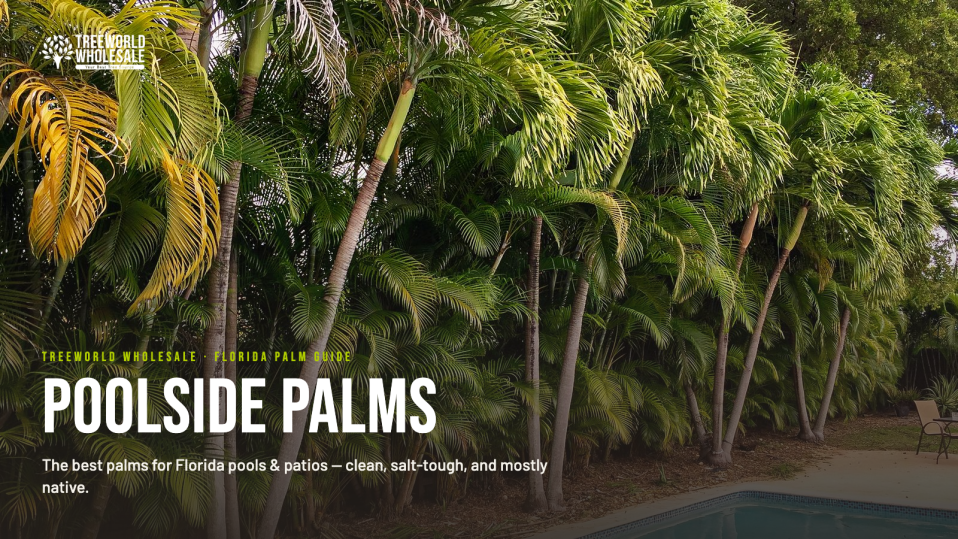
Poolside palms have one job: to turn a Florida afternoon into paradise — light off the water, the paver deck warm underfoot, a screened cage framing the sky, and almost always one palm doing the heavy lifting, the true key that makes the scene read tropical instead of a suburban rectangle of water.The inconvenience, because yes, in every paradise setting we need to tread carefully, is that palms aren’t always built for that spot. They shed. A heavy frond or a rain of fruit lands in the water, and now the skimmer basket is a weekly chore instead of an afterthought. Or they’re sold as patio palms and quietly become 40-foot trees that crowd the cage and drop debris three stories onto the deck. Or — the expensive one — their roots go looking for moisture and start lifting pavers, cracking the deck, pressing against the pool shell.
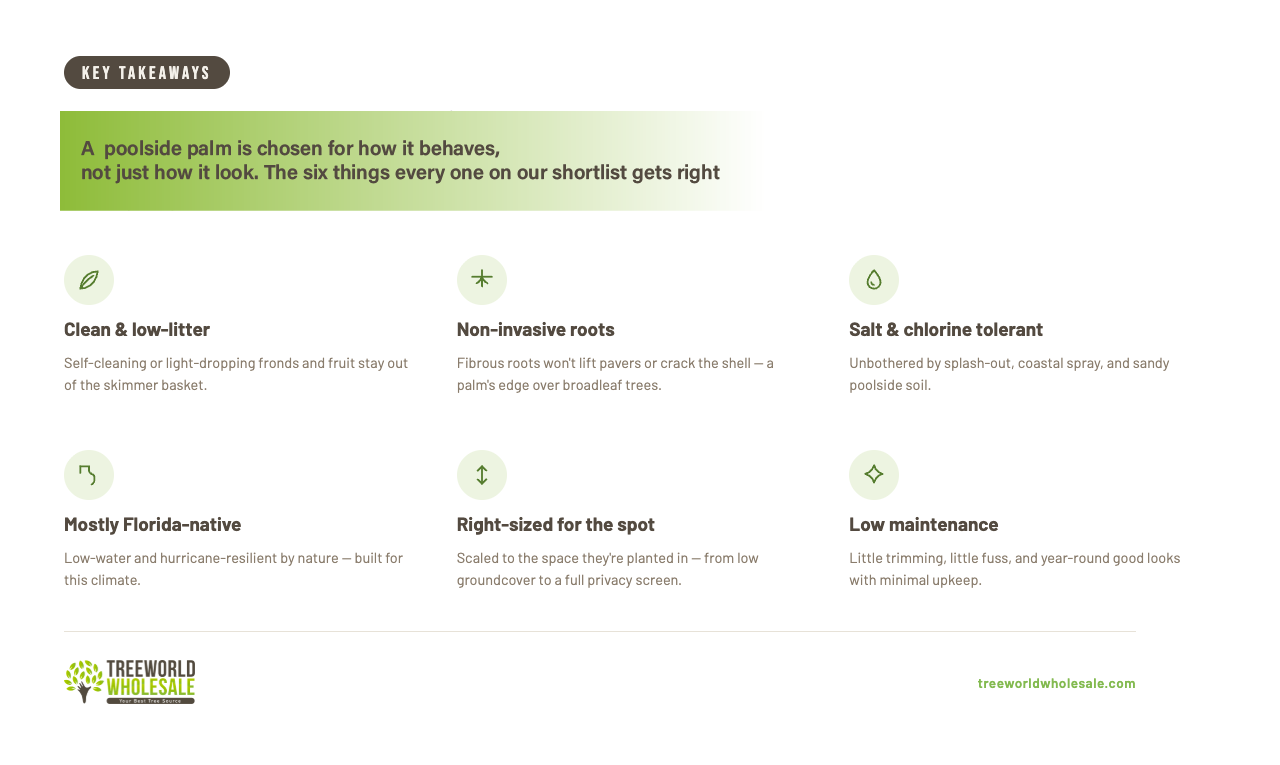
A palm that belongs beside a pool is chosen for how it behaves, not just how it looks:
- clean, non-invasive at the root,
- unbothered by salt and chlorine,
- scaled to the space it’s actually planted in.
So here’s our shortlist — five palms we grow that earn their place at the water’s edge, four of them Florida natives that were handling salt spray and sandy soil long before anyone poured a deck.
Key Takeaways:
- Choose a poolside palm for how it behaves — litter, roots, and salt tolerance matter more than looks
- Fibrous palm roots won’t lift pavers or crack the pool shell
- Four of the five are Florida natives — built for salt, drought, and hurricanes
- Cabada for privacy screens, Lady Palm for shade, Silver Palm for a specimen, Thatch palms for coastal exposure, Saw Palmetto for the base layer
- Even tough natives need consistent watering for the first 8–12 weeks after planting
What makes a palm right for a pool?
How to choose palms for pool landscaping in Florida?
- Litter is the dealbreaker.
Before anything else, ask what a palm drops and where it lands. Self-cleaning palms shed old fronds on their own and hold their fruit high and tidy; heavy droppers turn your skimmer into a part-time job and stain a paver deck. Near water, a clean habit isn’t a nice-to-have — it’s the whole point.
- Roots decide whether the hardscape survives.
This is the quiet advantage palms have over broadleaf shade trees: their root systems are fibrous and non-spreading, staying close to the trunk instead of ranging out to lift pavers, buckle the deck, or press against the pool shell. It’s exactly why a palm can live three feet from the coping when an oak never could.
- Salt and chlorine are constant, low-grade stress.
Splash-out, coastal spray, and salty irrigation are daily facts of a Florida pool. The palms that shrug this off — most of them native — keep their color instead of browning at the tips.
- Scale and light have to match the spot.
A palm sold as a patio plant can quietly become a 40-foot tree that overwhelms a screen cage. Match the mature size and the light before you fall for the look — a small palm in the right place beats a dramatic one in the wrong one.
- And mind bare feet.
Pools mean bare feet and kids. A few popular palms carry sharp spines at the frond base or drop staining fruit right where people walk — worth knowing before it’s planted at the edge of the deck.
Read more: Privacy Landscaping Ideas for Your Garden.
5 Best Poolside Palms for Florida Pools
Four of the five are Florida natives — the plants that were handling salt spray and sandy soil here long before the first pool was poured. That’s not a coincidence; it’s the whole reason they work.
Screen & privacy
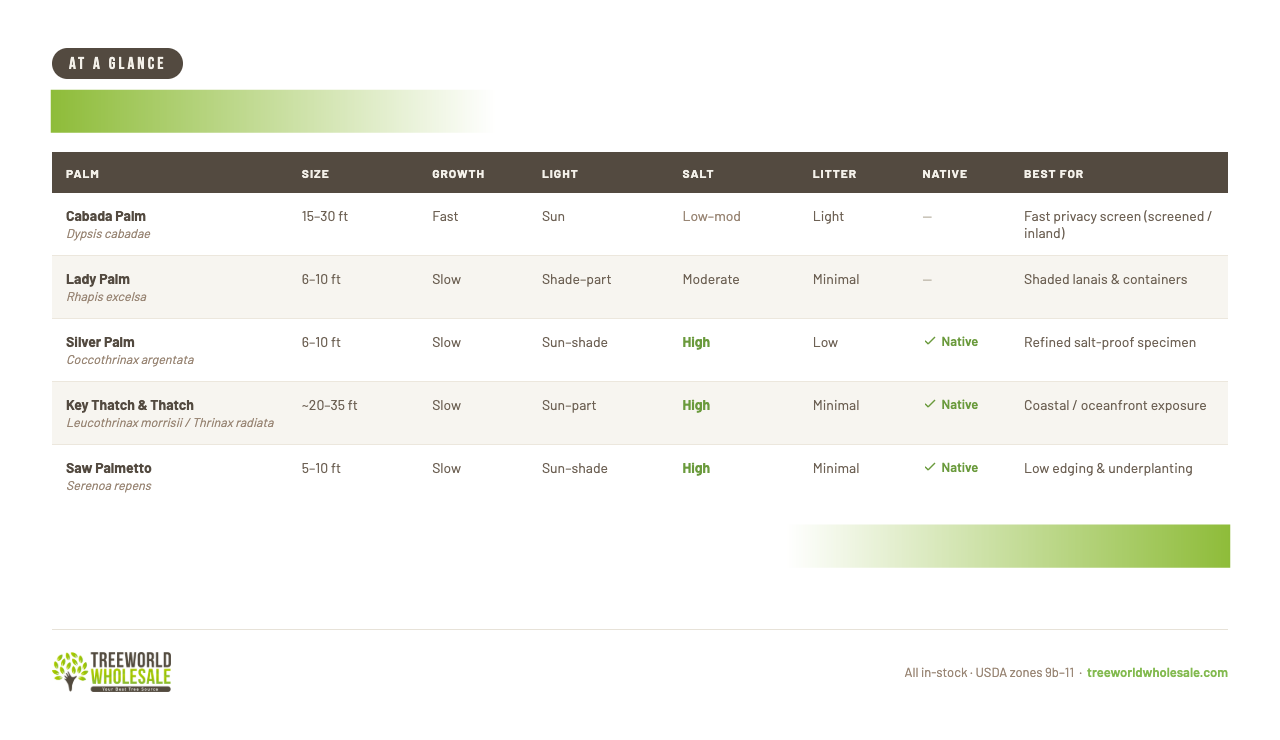
Cabada Palm — Dypsis cabadae
Our lead poolside palm, and the one people point at. Cabada clumps like green bamboo — smooth, ringed canes banded in waxy white, holding a light, feathery crown well overhead.
That’s the trick that makes it perfect near water: it gives you a fast, full privacy screen and a tropical backdrop without a heavy canopy hanging over the pool dropping shade and debris on the surface. It’s a fast grower, so a screen fills in quickly.
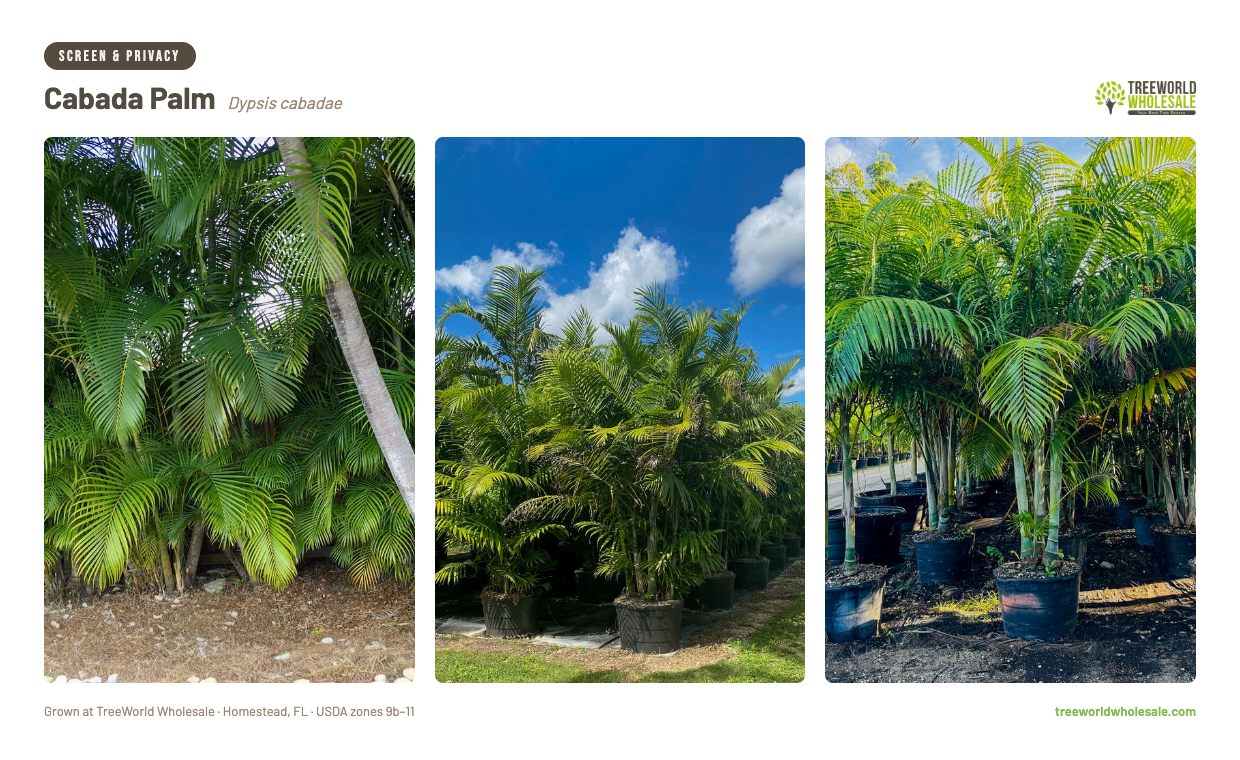
The one honest caveat: it’s not a salt palm and it likes consistently moist soil, so it’s happiest around a screened or inland pool rather than exposed oceanfront.
- Mature size: 15–30 ft tall, 12–20 ft clump
- Growth: fast · Light: full sun (tolerates part shade)
- Salt: low–moderate
- Litter: light, sheds cleanly ·
Choose it when you want a living privacy screen or green backdrop quickly, and the pool is screened or set back from the coast.
Lady Palm — Rhapis excelsa
The shade specialist. Where Cabada wants sun, Lady Palm thrives in the low light most palms hate:
- a screened cage,
- a covered lanai,
- the north-facing wall that stays dim all afternoon.
It’s a slow, clumping fan palm on slim bamboo-like canes, and it’s about as close to litter-free as a palm gets, which is exactly what you want a few feet from the water. Keep it out of the hot direct sun, where the fronds bleach, and out of salty exposure.
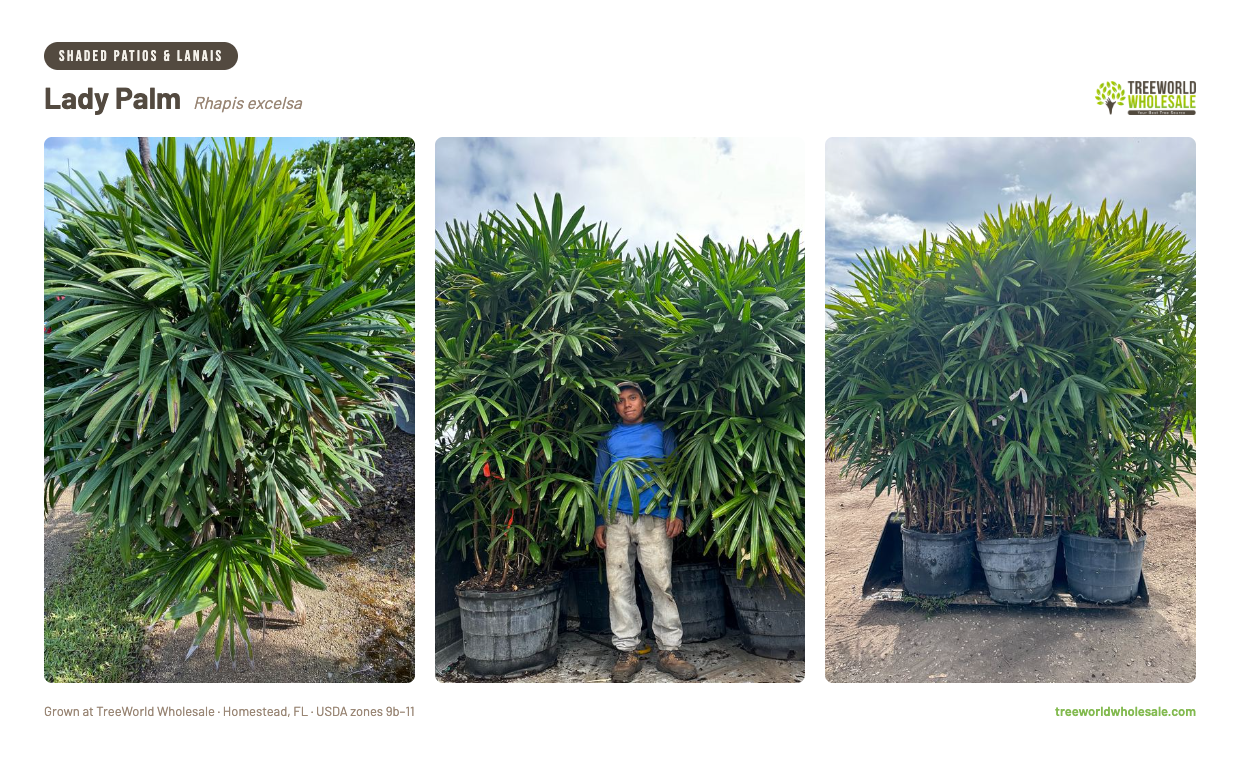
- Mature size: 6–10 ft (occasionally to ~13)
- Growth: slow
- Light: shade to part shade
- Salt: moderate
- Litter: minimal
Choose it when the spot is shaded and you want a clean, refined palm with essentially no mess.
Silver Palm — Coccothrinax argentata
A native jewel and a genuine specimen plant. Silver Palm has single slender trunk, stiff fan leaves that are deep blue-green on top and flash bright silver underneath every time the wind moves — it practically animates a still corner of the deck. It’s slow (a few inches a year), which is a feature here: it holds its scale close to the coping for years. High salt and drought tolerance, and no fuss.
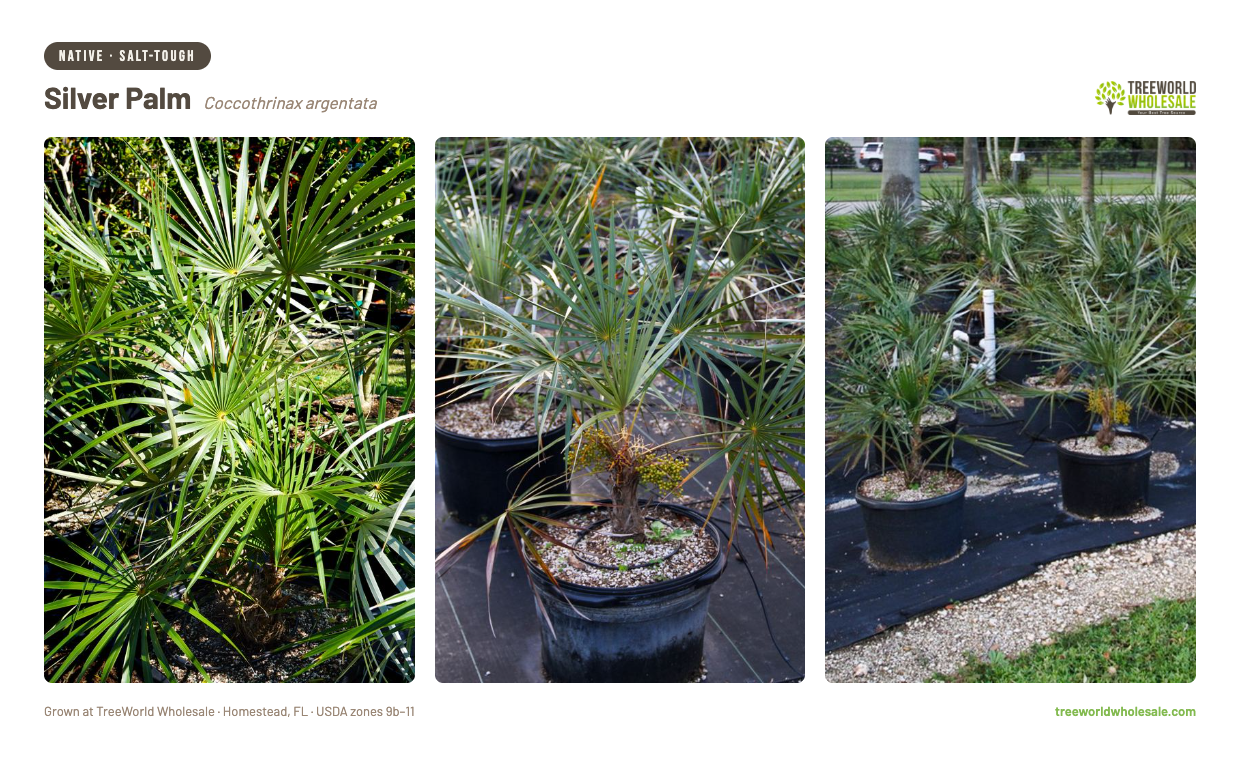
- Mature size: 6–10 ft (to ~15 over decades)
- Growth: slow
- Light: full sun to shade
- Salt: high
- Litter: low
Choose it when you want a refined, salt-proof specimen that stays small near the water.
Key Thatch & Florida Thatch Palm — Leucothrinax morrisii / Thrinax radiata
The two native fan palms coastal Florida grew up on, and the toughest things on this list. Both shrug off salt spray, wind, and drought — this is what actually lines the Keys — and neither is a litter problem. Rounded, architectural fan crowns on clean trunks.
They’re slow, so they keep their scale for years; Key Thatch will eventually reach 20–35 ft where Florida Thatch settles around 20. If your pool takes real coastal exposure, these are the palms that won’t brown out.
- Mature size: ~20–35 ft (very slow)
- Growth: slow (~6 in/yr)
- Light: full sun to part shade
- Salt: high
- Litter: minimal
Choose it when salt spray and wind are the real challenge and you want native, clean, and close to bulletproof.
Saw Palmetto — Serenoa repens
Not a canopy palm — the groundwork. Saw palmetto is low and clumping, crawling along at 5–10 ft, and it’s what softens the hard edge of a deck, anchors a planting bed, screens the equipment pad, or underplants the taller palms above. Green or a striking silver-blue depending on the form. It’s a Florida native famous for surviving salt, drought, and even fire, and it asks for essentially nothing once established
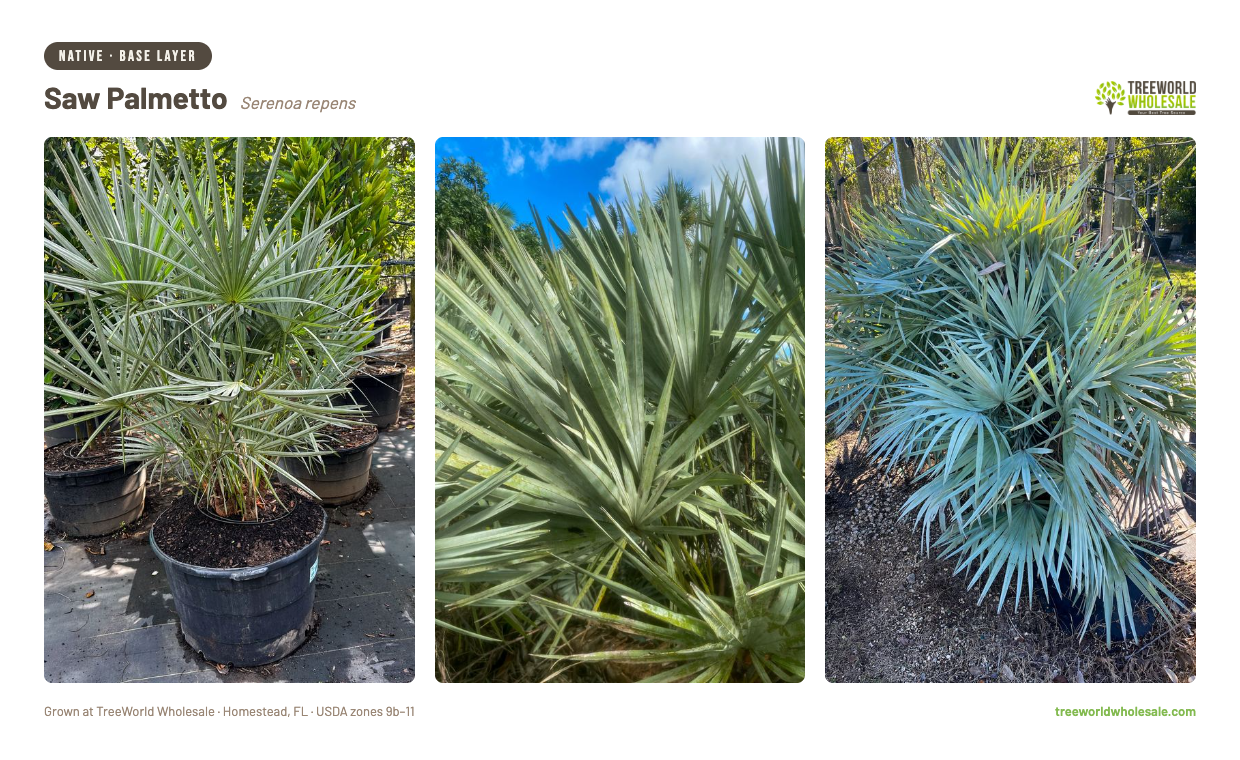
- Mature size: 5–10 ft tall, 4–10 ft spread
- Growth: slow
- Light: full sun to shade
- Salt: high
- Litter: minimal
Choose it when you need low, tough, native texture at the base — edging, softening hardscape, or hiding the pool equipment.
Poolside palms compared
Putting them together around the pool
The palms above each play a different role, and good pool landscaping is mostly about casting them well.
- Cabada is the backdrop — a tall, open screen along the fence line that gives privacy without hanging a canopy over the water.
- Silver Palm is the specimen you plant to be looked at.
- The thatch palms take the salt-splash zone right at the coping, where softer palms brown out.
- Saw Palmetto is the base layer that softens the deck edge and hides the equipment pad.
- Lady Palm is for the shaded corners and screened lanais nothing else will tolerate.
Two things to get right: keep even non-invasive palms a foot or two off the coping, and check mature height against a screen enclosure — plant Cabada and the thatches outside the cage, keep the shorter Silver and Lady within.
Everything else comes back to the same test: near water, plant for how a palm behaves, not just how it looks.
Find Your Perfect Poolside Palm
The right poolside palm is a lot easier to choose standing next to it. At TreeWorld Wholesale in Homestead we grow all five — Cabada, Lady Palm, Silver Palm, Key Thatch and Florida Thatch, and Saw Palmetto — in sizes from 25 gallons up, and we’re happy to walk the rows with you and match the palm to the spot: the light it gets, the salt it’ll take, the height that has to clear a screen cage. Whether you’re a designer speccing a project or a homeowner planting one pool, we’ll help you get it right the first time.
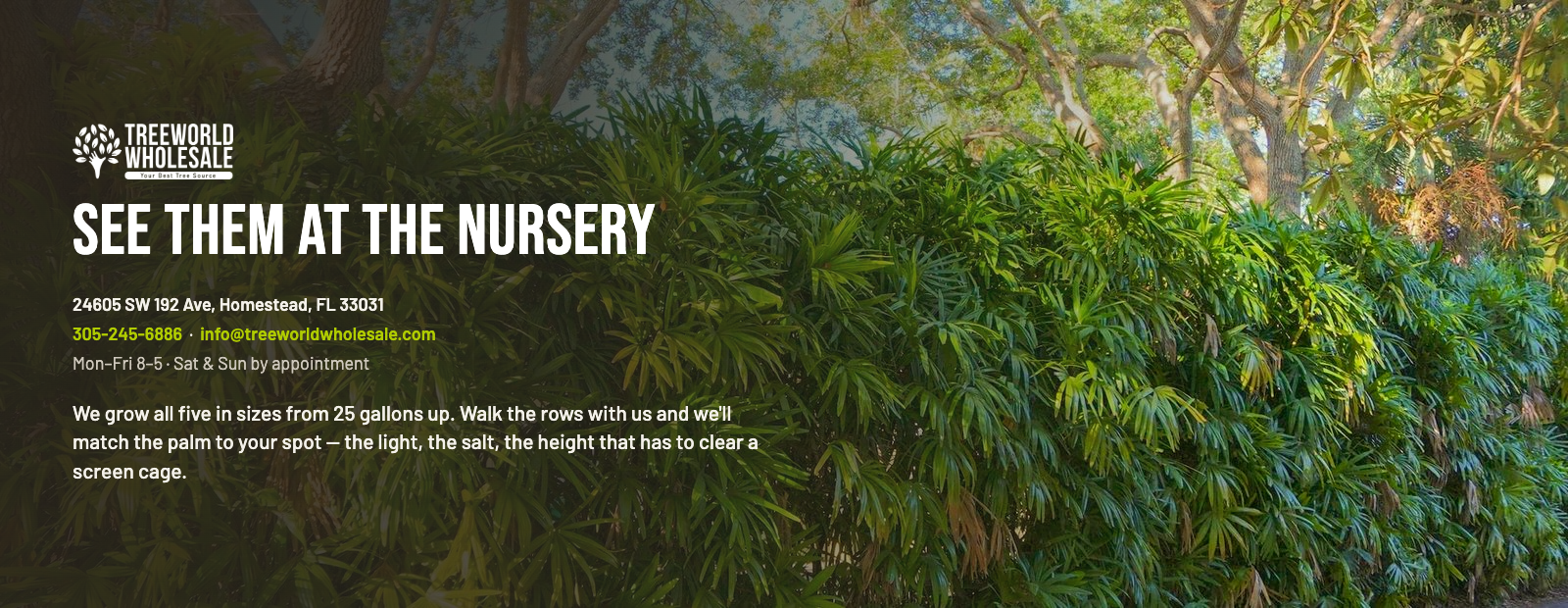
TreeWorld Wholesale:
📍 24605 SW 192 Ave, Homestead, FL 33031 (Mon–Fri 8–5 · Sat & Sun by appointment)
📞 305-245-6886
✉️ info@treeworldwholesale.com