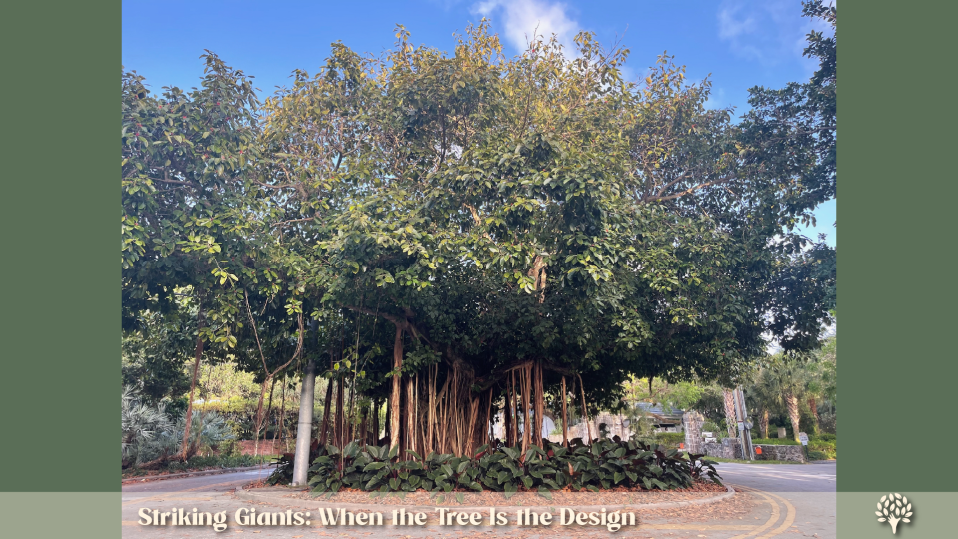
Large trees —the ones that make people stop mid-conversation. The kind that landscape architects photograph before they even write a spec. The ones that turn a well-designed project into something people remember for years.
This is about those trees — the large and giant trees that don’t fill a design. They build it.
At TreeWorld Wholesale, we grow a selection of giants and architectural standouts that belong in a category of their own. Whether you’re designing an estate in South Florida, a resort in the Caribbean, or a public space that needs a defining focal point, these are the species worth building around.
Key Takeaways:
- Large and giant trees serve as landscape design anchors, not filler — they define a property’s layout rather than just occupying space.
- The Banyan (Ficus benghalensis) can spread over 100 feet via aerial prop roots that form secondary trunks.
- The African Baobab (Adansonia digitata) grows slowly and can live over 1,000 years, making mature specimens especially valuable.
- Silk-cotton trees (Bombax ceiba, Ceiba speciosa, Ceiba pentandra) combine sculptural trunks with seasonal flowering.
- Samanea saman (Rain Tree) offers the widest canopy on this list — up to 100 feet — ideal for shading large courtyards and lawns.
- Giant trees require more root zone space, soil prep, and irrigation planning than standard canopy trees.
- TreeWorld Wholesale supplies these species in containers from 25 to 600 gallons for immediate landscape impact.
The Banyan: One Tree That Becomes a Landscape
Ficus benghalensis
If there is one tree that turns a landscape into a living structure, it’s the Banyan. What begins as a single trunk eventually sends aerial prop roots downward from its branches — each one reaching the soil, thickening into a secondary trunk, then another, and another. A mature Ficus benghalensis doesn’t occupy a landscape. It becomes one.
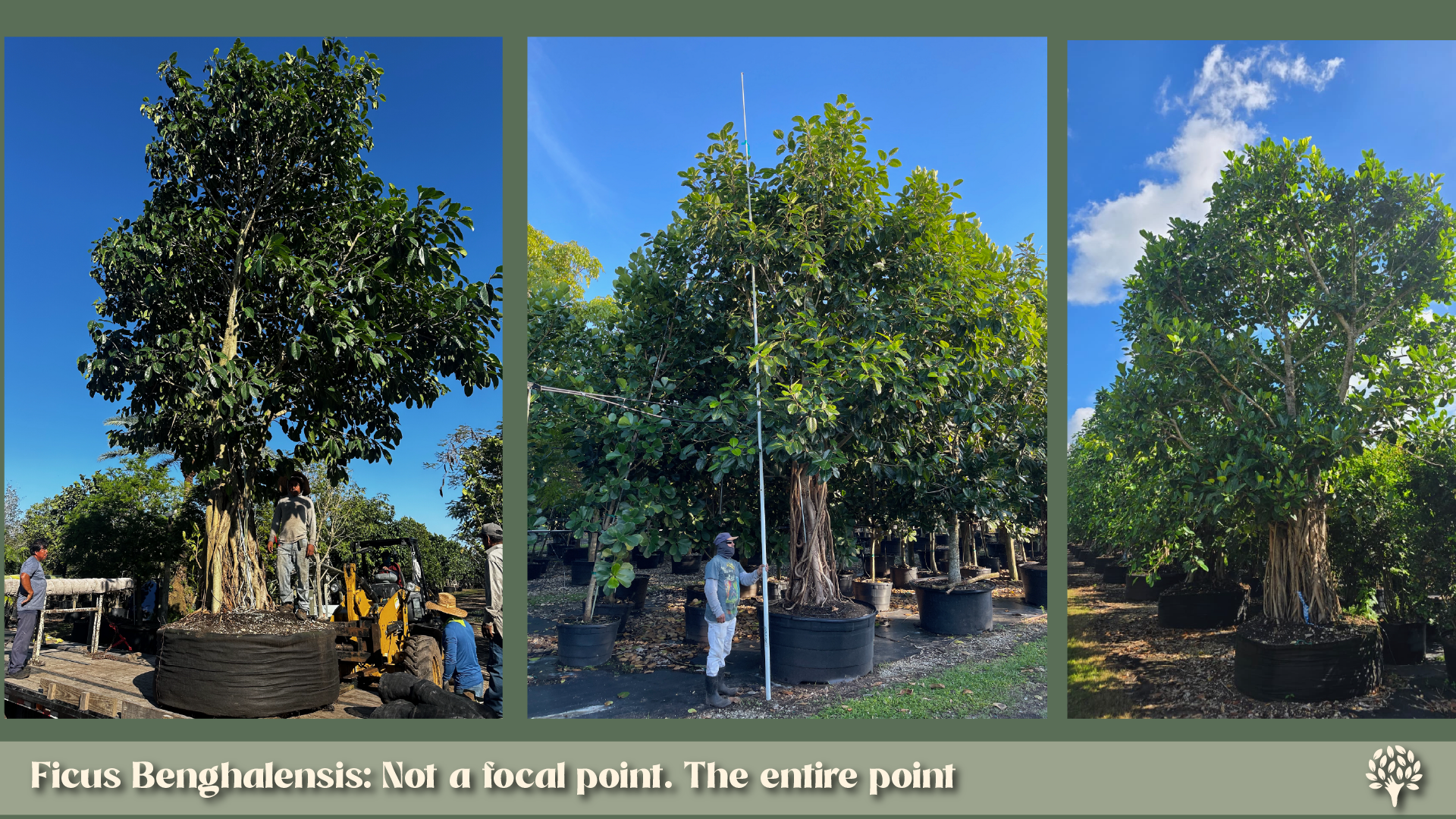
The canopy spread of a well-established banyan can exceed 100 feet. The famous Great Banyan in India covers nearly four acres with over 3,000 aerial roots. For landscape purposes, that scale means shade, spatial presence, and a design anchor unlike anything else in the plant palette.
Placement and root zone planning matter — banyans need generous space away from infrastructure — but for large residential estates, resort grounds, and parks, nothing delivers the same visual return on investment.
The Ficus That Surprise You
Not all ficus are created equal. Two species in our collection deserve more attention than they typically get.
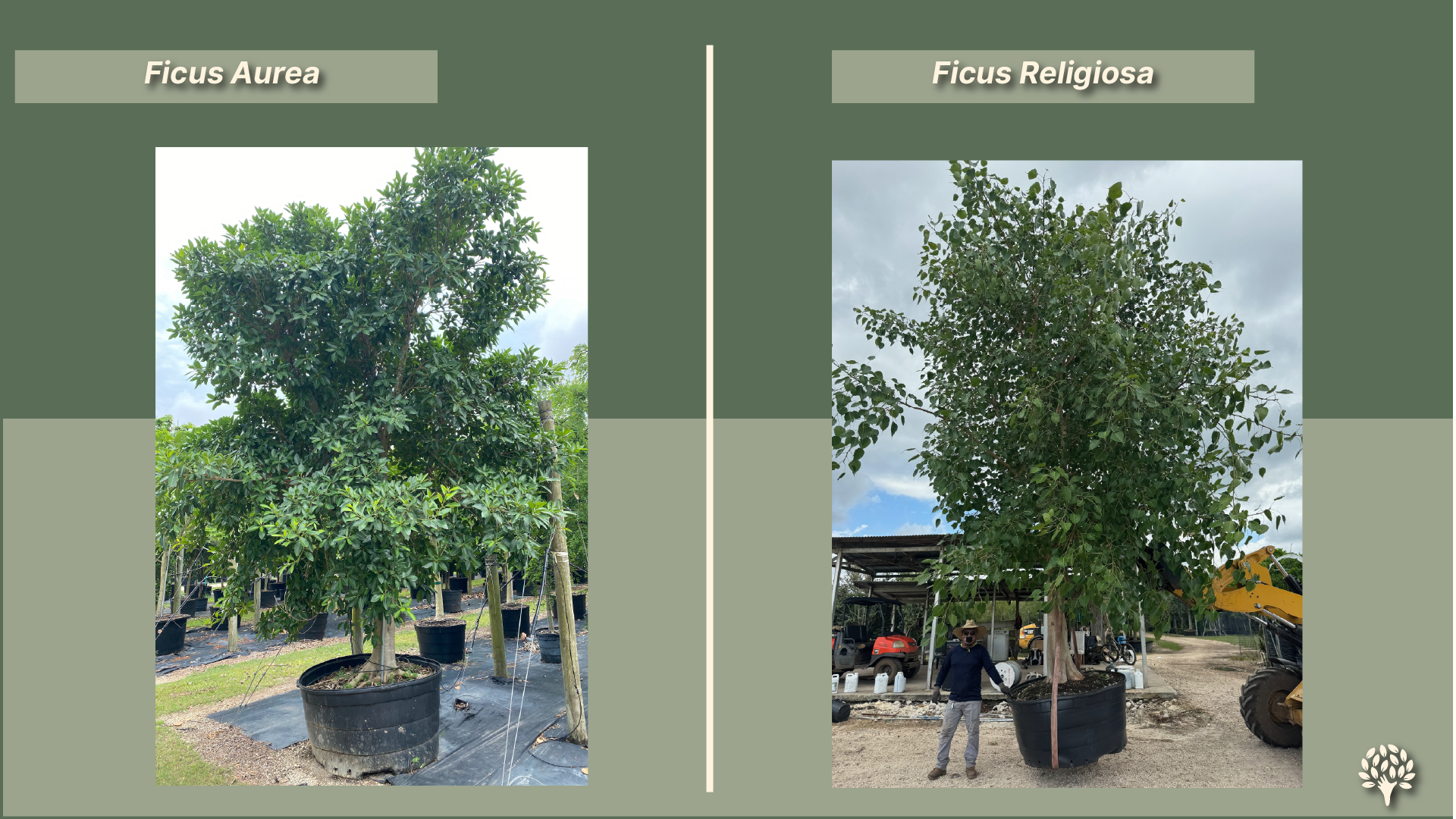
Ficus religiosa — Sacred Fig
Most people know the Sacred Fig through its cultural significance — the tree under which the Buddha attained enlightenment, venerated across South and Southeast Asia for millennia. Fewer know it as the landscape specimen it truly is.
Ficus religiosa can reach 100 feet with a wide-spreading crown, and it has a brief deciduous period in the dry season that creates a dramatic reveal before the distinctive heart-shaped leaves emerge again. Highly tolerant of full sun and poor soils, it brings spiritual resonance and genuine scale to any large landscape.
Ficus aurea — Florida Strangler Fig
The Strangler Fig earns its name through one of nature’s most compelling growth habits: it begins life as an epiphyte, germinating high in a host tree’s canopy and sending roots downward until they reach the soil. Those roots eventually merge into a latticed, sculptural trunk of extraordinary character.
As a landscape specimen started in the ground, Ficus aurea develops an irregular, organic form that no two specimens share. It’s also a Florida native — carrying real value for:
- biodiversity,
- wildlife habitat,
- native landscape certification.
Its tolerance of coastal conditions and periodic flooding makes it one of the most adaptable giants on this list.
The Silk-Cotton Family: Trunk as Architecture
This group doesn’t just grow tall — they make an entrance. The silk-cotton family (Bombacaceae/Malvaceae) shares a common trait: trunks that function as sculpture before the canopy even comes into view.
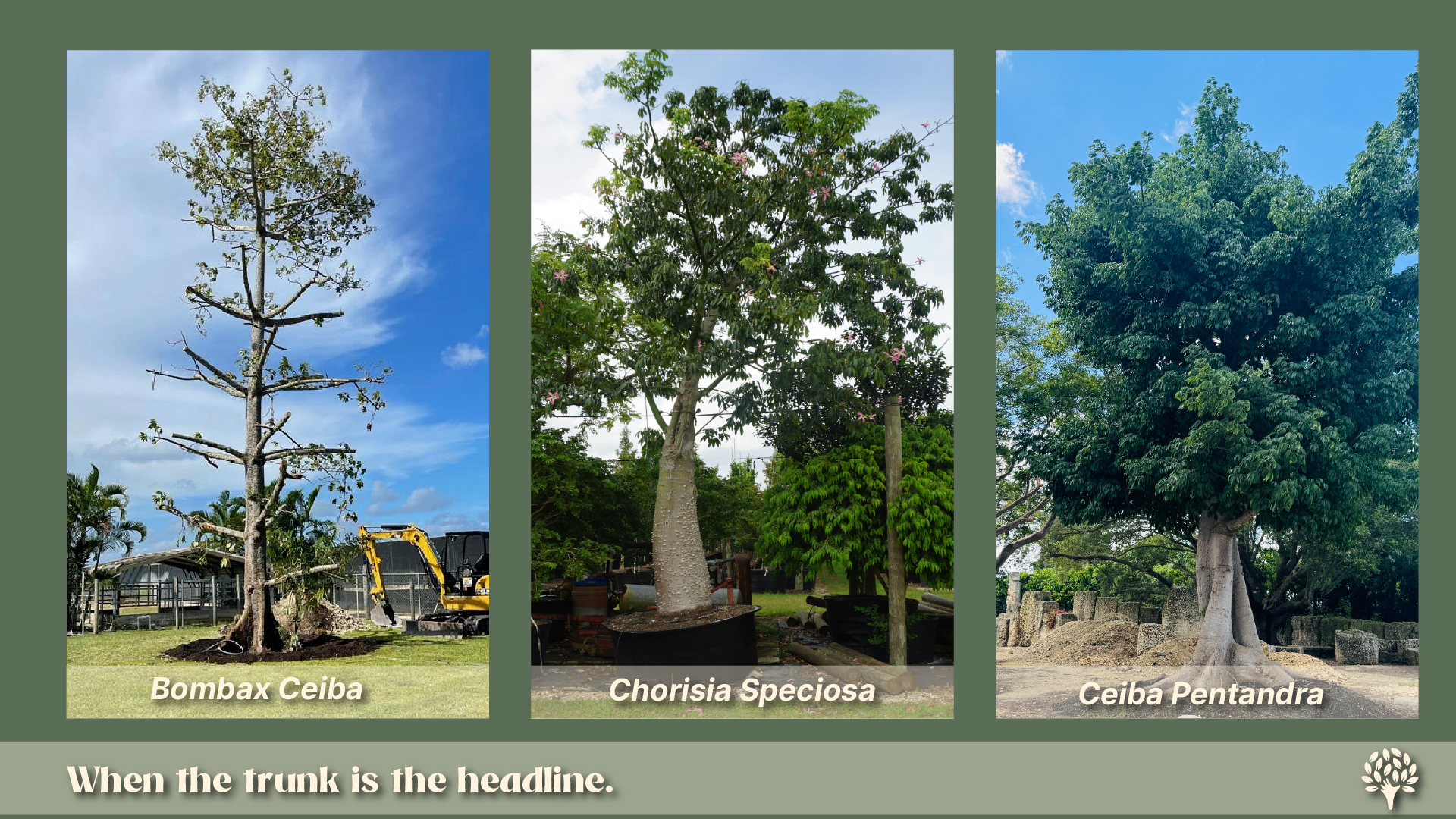
Bombax ceiba — Red Silk Cotton Tree
Before tropical landscape design discovered its love for flowering canopies, Bombax ceiba was already setting the standard. Its brilliant scarlet cup-shaped flowers appear in late winter and early spring — before the leaves, covering the entire crown in red at a moment when most of the surrounding landscape is still quiet. The spiny, buttressed trunk and strong horizontal branching give it year-round architectural presence, even between flowering seasons. It can reach 60–80 feet and thrives in South Florida’s heat and full sun.
Ceiba speciosa — Floss Silk Tree
Formerly known as Chorisia speciosa, this tree brings a different kind of drama: a bottle-shaped trunk studded with conical spines in youth, and large pink-to-magenta flowers in fall when the rest of the landscape has largely wound down.
The blooms — up to four inches across with a white center — often appear from a nearly bare canopy, which makes the effect feel theatrical rather than incidental. At 40–60 feet, Ceiba speciosa is the most accessible of the family for residential estates and commercial properties with moderate acreage.
Ceiba pentandra — Kapok
The true giant of the family. In its native tropical range, Ceiba pentandra reaches 200 feet; in South Florida it grows more moderately but still achieves a scale and canopy presence that few trees can match. Its buttress roots — massive plank-like structures radiating from the base — are among the most architecturally striking features available in the South Florida plant palette. This is not a residential tree.
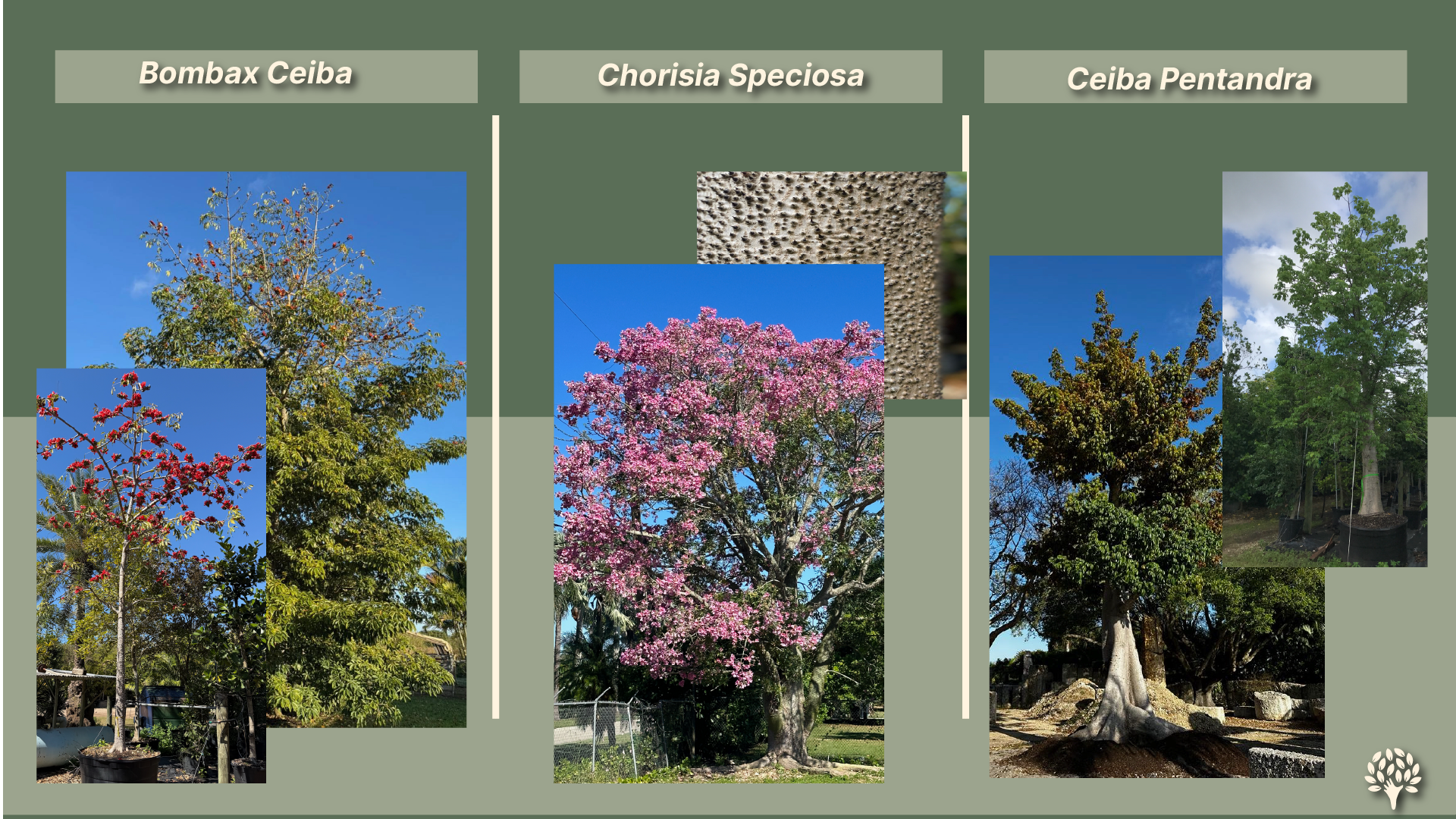
It’s a resort tree, a botanical garden tree, a destination. When the site has the scale and the vision, there is nothing quite like it.
The Undeniable Giant: Adansonia digitata
The African Baobab deserves its own section because it operates by its own logic entirely.
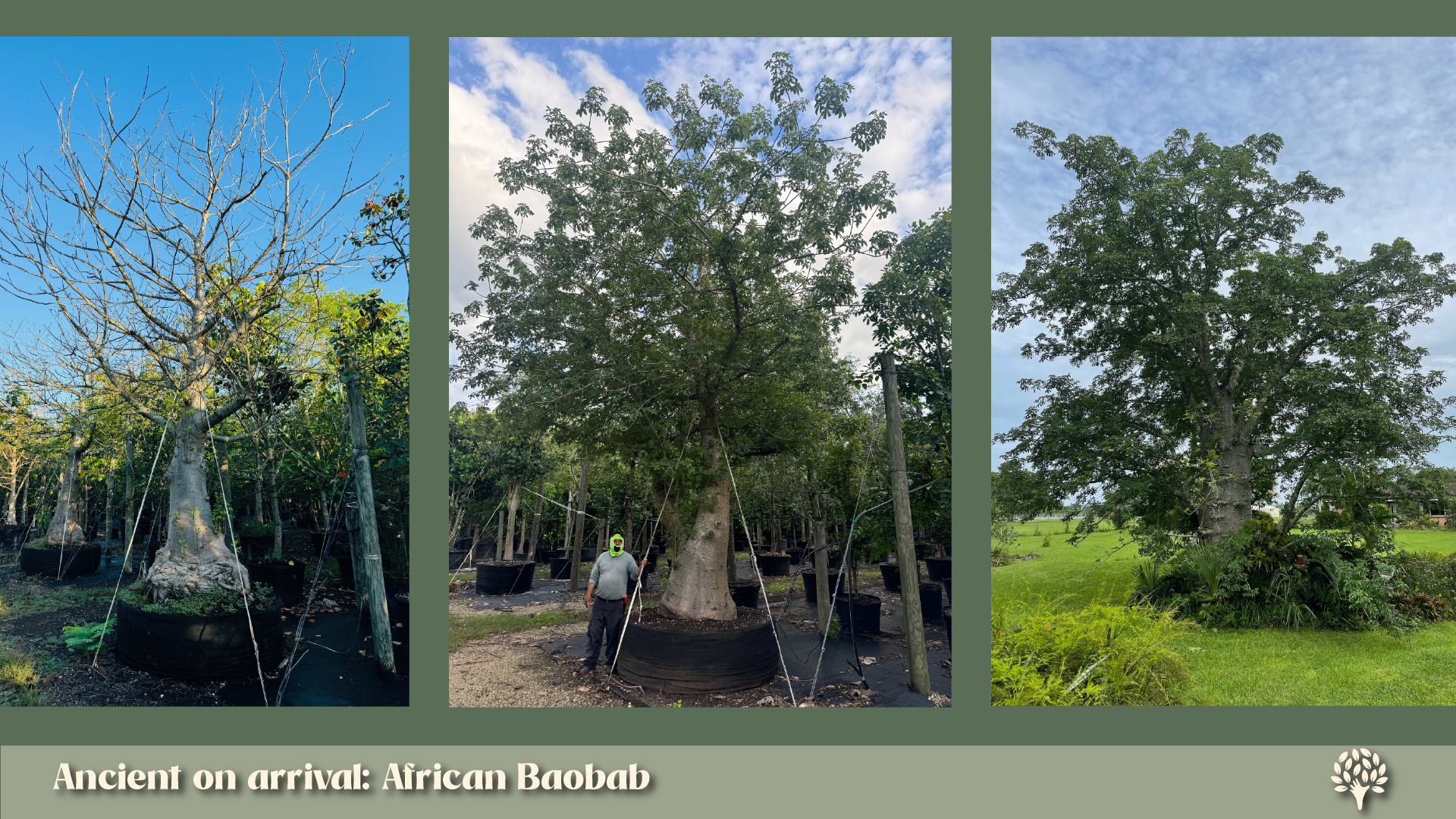
It doesn’t grow tall so much as it grows massive. A trunk that can exceed 30 feet in diameter. A canopy that looks, famously, like a tree turned upside down, its bare branches resembling roots reaching into the sky. A lifespan measured not in decades but in centuries — some specimens alive today are over a thousand years old.
The name comes from the tree’s behavior — the leaflets fold in response to approaching rain and close again at nightfall. It’s a quiet trait, easy to miss, but clients who notice it tend to remember it long after a project wraps. Pink pom-pom flowers add seasonal color, and its adaptability to a range of soil types makes it one of the more forgiving giants to establish.
For resort pools, large courtyards, or open estate lawns, Samanea saman delivers the kind of presence that becomes the most-photographed element of a completed landscape.
The Tropical Charmer: Samanea saman — Rain Tree
The Rain Tree earns its place on this list not through height but through sheer horizontal presence. Its canopy can spread 80 to 100 feet wide, creating a broad, flat-topped structure that dwarfs most canopy trees in terms of spatial coverage.
The silhouette is instantly recognizable: a generous umbrella of delicate, feathery bipinnate leaves casting layered, dappled shade across everything below.
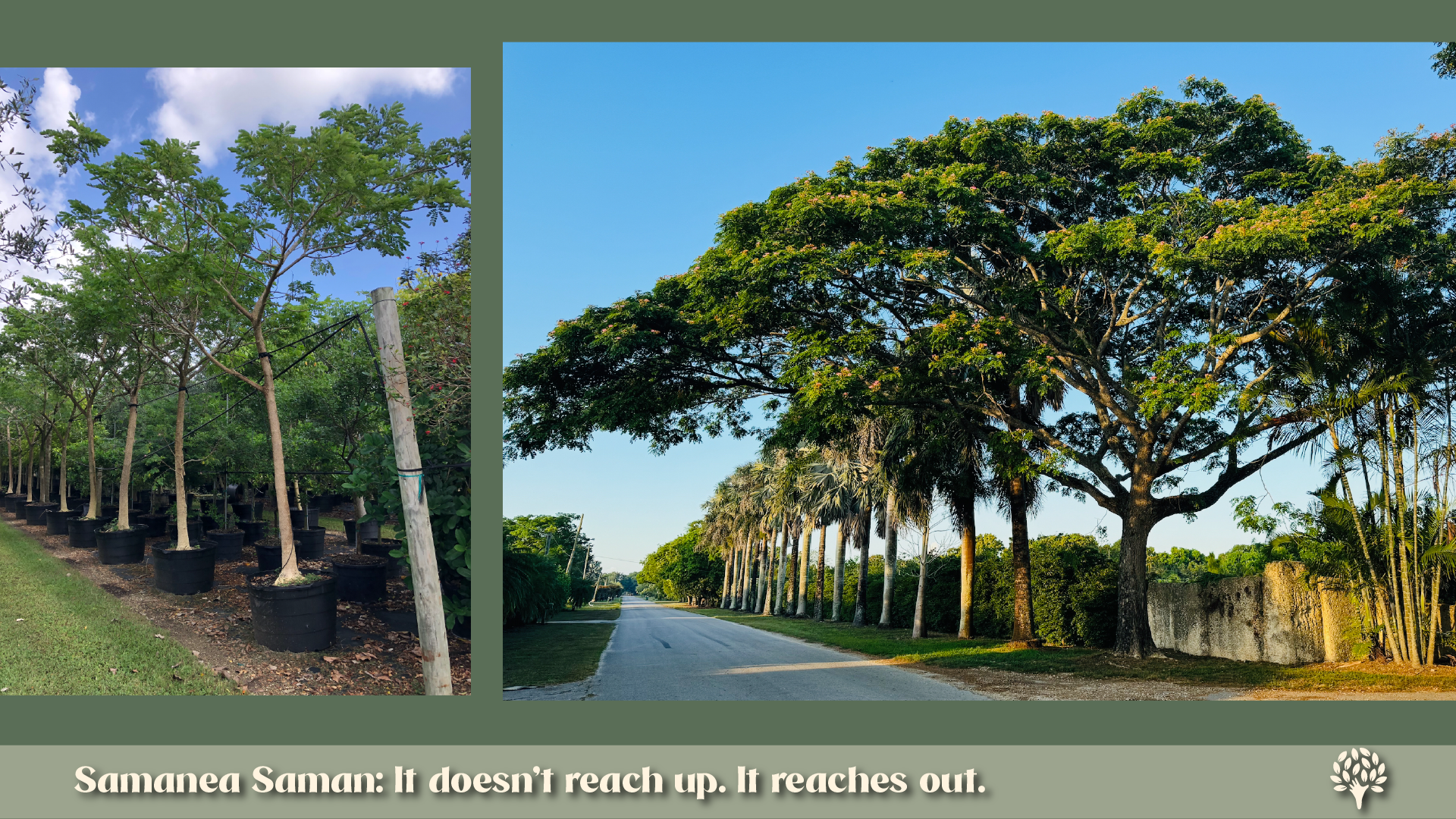
The name comes from the tree’s behavior — the leaflets fold in response to approaching rain and close again at nightfall. It’s a quiet trait, easy to miss, but clients who notice it tend to remember it long after a project wraps. Pink pom-pom flowers add seasonal color, and its adaptability to a range of soil types makes it one of the more forgiving giants to establish.
For resort pools, large courtyards, or open estate lawns, Samanea saman delivers the kind of presence that becomes the most-photographed element of a completed landscape.
Designing With Giants
Every tree on this list demands space, intention, and a long view. These aren’t trees you plant to fill a gap — they’re trees you plan around, the way an architect plans around a load-bearing wall. Soil preparation, root zone allowance, irrigation design, and container sizing all carry more weight at this scale.
At TreeWorld Wholesale, we grow these specimens in containers ranging from 25 gallons up to 600 gallons, giving landscape professionals access to material with genuine presence from the day of installation.
If you’re specifying any of these for an upcoming project, contact us — we can walk you through current availability, sizing, and site suitability.
Some landscapes are built around plants. The best ones are built around giants.
📍 24605 SW 192 Ave, Homestead, FL 33031
📞 305-245-6886
✉️ info@treeworldwholesale.com
Frequently Asked Questions About Landscaping with Large Trees in Florida
What are the best large trees for landscaping in Florida?
Some of the best large trees for Florida landscaping include the Banyan (Ficus benghalensis), African Baobab (Adansonia digitata), Kapok (Ceiba pentandra), and Rain Tree (Samanea saman). Each offers a different combination of canopy size, trunk architecture, and seasonal interest suited to South Florida’s climate.
How much space do giant trees need in a landscape design?
Giant trees like the Banyan or Rain Tree need generous root zone space — often 80 to 100 feet of canopy spread at maturity — along with distance from infrastructure, foundations, and underground utilities. Planning root zone allowance early avoids costly conflicts later.
Which large trees are native to Florida?
Ficus aurea (Florida Strangler Fig) is native to Florida and adds ecological value through wildlife habitat support and native landscape certification, in addition to its sculptural, irregular growth form.
What size containers are large landscape trees sold in?
TreeWorld Wholesale grows large and giant specimen trees in containers ranging from 25 gallons up to 600 gallons, giving landscape professionals immediate visual impact at installation rather than waiting years for trees to mature on-site.
Are giant trees suitable for residential properties, or only large commercial sites?
It depends on the species and scale of the property. Trees like Ceiba speciosa (Floss Silk Tree) work well on residential estates and moderate-acreage commercial sites, while trees like Ceiba pentandra (Kapok) or Ficus benghalensis (Banyan) are better suited to resorts, parks, and large estates with the space to accommodate their full mature spread.
How long do large landscape trees like the Baobab take to mature?
The African Baobab grows slowly, often taking decades to reach significant size, which is part of what makes mature specimens valuable. Other giants, like the Rain Tree or Banyan, establish more quickly and still provide meaningful shade and canopy presence within several years of installation.