
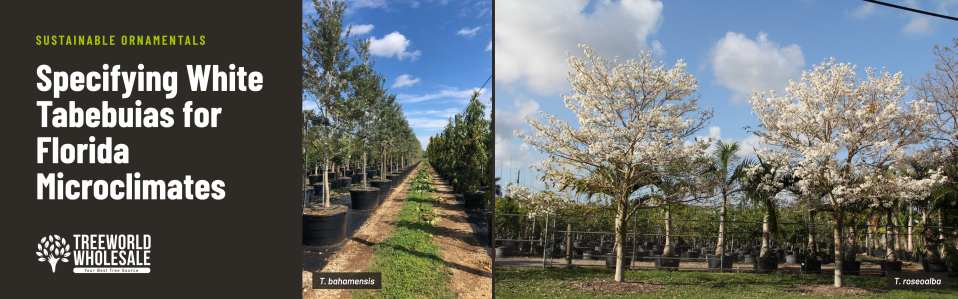
The landscaping industry is facing a new reality. Extreme heat, unexpected cold snaps, and intense storms are challenging the viability of traditional landscape designs across Florida and the Caribbean. As unpredictable weather patterns become the norm, landscape architects and municipal review boards are actively shifting away from high-maintenance and water-heavy trees.
Instead, they are specifying resilient, high-impact ornamentals like the white tabebuia—a species currently dominating search trends. It serves as a perfect example of how to anchor sustainable designs amidst this industry shift. However, this transition still poses a significant challenge, especially when specifying flowering tropicals.
The most common dilemma is:
How do we maintain the dramatic, high-impact aesthetics expected in high-end projects while adhering to Florida-Friendly Landscaping principles and tightening water restrictions?
The answer lies in precise species selection. While “white Handroanthus” (formerly known as “white tabebuia”) is frequently searched and requested, success comes down to specifying the exact species: Tabebuia roseoalba versus Tabebuia bahamensis. These white-blooming specimens offer the explosive visual appeal of traditional tropicals, but when specified correctly for their respective microclimates, they serve as highly sustainable, resilient components of a modern landscape.
Key Takeaways:
- Microclimate over aesthetics: Match the species to specific site conditions.
- T. roseoalba (Ipê Branco): Showy tropical bloom; needs shelter from frost, wind, and salt (Zones 10A–11).
- T. bahamensis (Bahama White): Tougher, highly tolerant to wind, salt, and urban conditions (Zones 9B–11).
- Site factors: Check heat, wind, drainage, salt, and root space before selection.
- Resilience: Both are drought-tolerant once established; deep watering before freezes protects tender species (T. roseoalba).
- Approvals: Site-matched planting aligns with Florida-Friendly standards for faster HOA/municipal approval.
Why Florida Landscape Architects Are Rethinking Tree Selection?
As we discussed in our recent guide, Florida Cold Front 2026: How It Affects Your Landscape, we can no longer rely on geographical averages to guarantee a tree’s success.
As TreeWorld Wholesale owner Guillermo Valenzuela often says:
“Not all trees read the same books.”
Designing for climate resilience requires acknowledging that species respond differently to environmental stress based on their growth habit, physiology, and evolutionary history. A sustainable landscape design anchors a project with highly tolerant structural trees (like Live Oaks or Bucida buceras) while layering more sensitive tropical ornamentals strategically.
Striking the heart of modern, sustainable landscape architecture. It represents a shift from aesthetic-first design to microclimate-driven specification. Further on this philosophy transforms it from a simple planting guideline into a compelling strategic argument for urban developers and landscape architects.
When specifying white-flowering Tabebuias, rather than placing a tree where we want it to grow, we must specify the tree engineered for the microclimate we have. Here is why:
Deconstructing the Urban Microclimate
To successfully specify a white-flowering Tabebuia, designers must look past regional hardiness zones and analyze the hyper-local realities of the planting site. A microclimate is defined by highly localized variables that can change drastically within a single property line:
- Thermal Loading and Reflected Heat: Urban sites are defined by hardscapes. Reflected heat from asphalt, structural glass, and concrete walls drastically raises the ambient temperature and evaporation rates compared to a natural canopy setting.
- Altered Hydrology and Drainage: Municipal swales, compacted construction soils, and raised planters completely alter natural water flow. A tree must be matched to the exact drainage reality of its 10-foot radius.
- Wind Corridors and Salt Exposure: Especially in coastal or high-density environments, building orientations can create aggressive wind tunnels or expose canopies to elevated aerosolized salt.
- Subterranean Restrictions: Rooting volume is often restricted by utility lines, foundation footings, and retaining walls, requiring trees with specific root architectures that won’t compromise municipal infrastructure.
Microclimate Match-Up
Historically, urban landscaping has operated on a forced-fit model: selecting a desired aesthetic—like the striking, architectural blooms of a white-flowering Tabebuia—and attempting to bend the environment to support it.
Read more: Tabebuias, a flowering favorite!
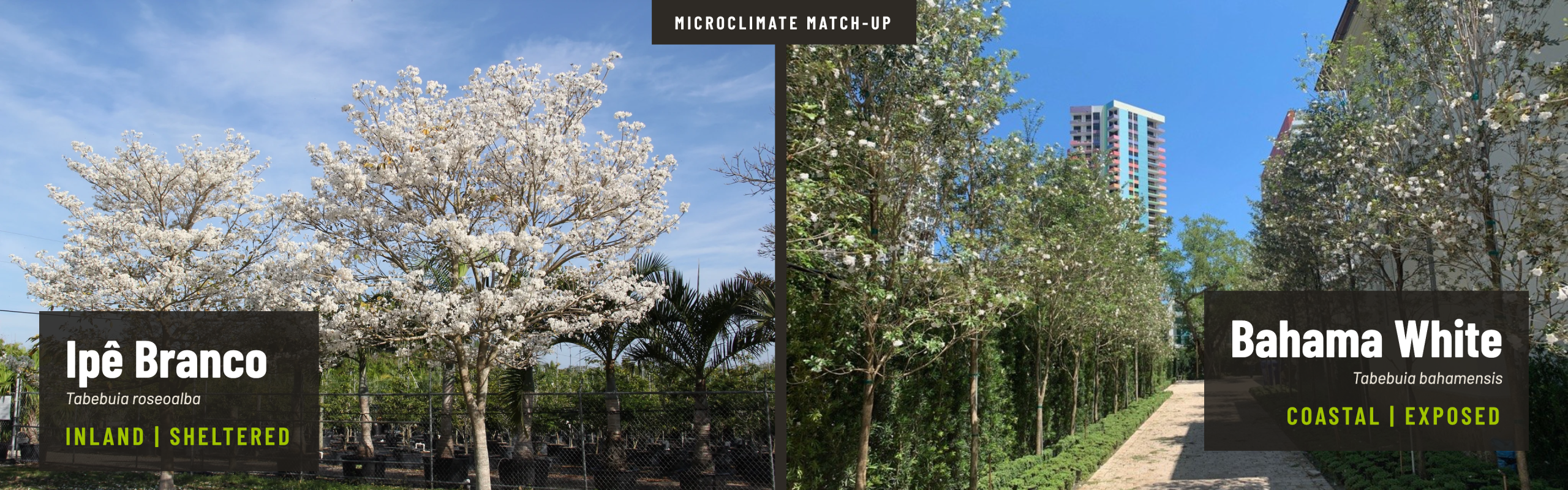
The modern standard requires the inverse. We must treat the microclimate as the unyielding foundation and specify trees that possess the biological engineering to thrive within those exact parameters. This microclimate-first approach is the highest-level execution of the Florida-Friendly Landscaping (FFL) program’s defining principle: ‘Right Plant, Right Place.’
By matching a tree’s natural physiological tolerances to the exact hydrology and thermal loading of the site, designers eliminate the need for heavy supplemental irrigation and aggressive chemical intervention. More importantly, framing your plant selection around this core FFL principle practically guarantees rapid approval from strict municipal review boards and local HOAs, smoothing out the permitting process for developers.
When a landscape architect shifts to this site-first mentality, the tree becomes a specialized tool to solve an environmental puzzle, rather than just a decorative element hoping to survive.
White Tabebuia Trees: Two Species, Two Very Different Microclimates
White-flowering Tabebuias are prized for their spectacular, leafless floral displays and elegant structural form. However, specifying them successfully requires respecting their biological baselines.
Species Spotlight: Tabebuia roseoalba (Ipê Branco)
Known globally as the Ipê Branco, Tabebuia roseoalba (often reclassified botanically as Handroanthus roseoalbus) is the quintessential statement tree. When it defoliates and blooms, the entire canopy explodes in dense, pure white clusters, creating a dramatic “snow in the tropics” effect that few other ornamental trees can match.
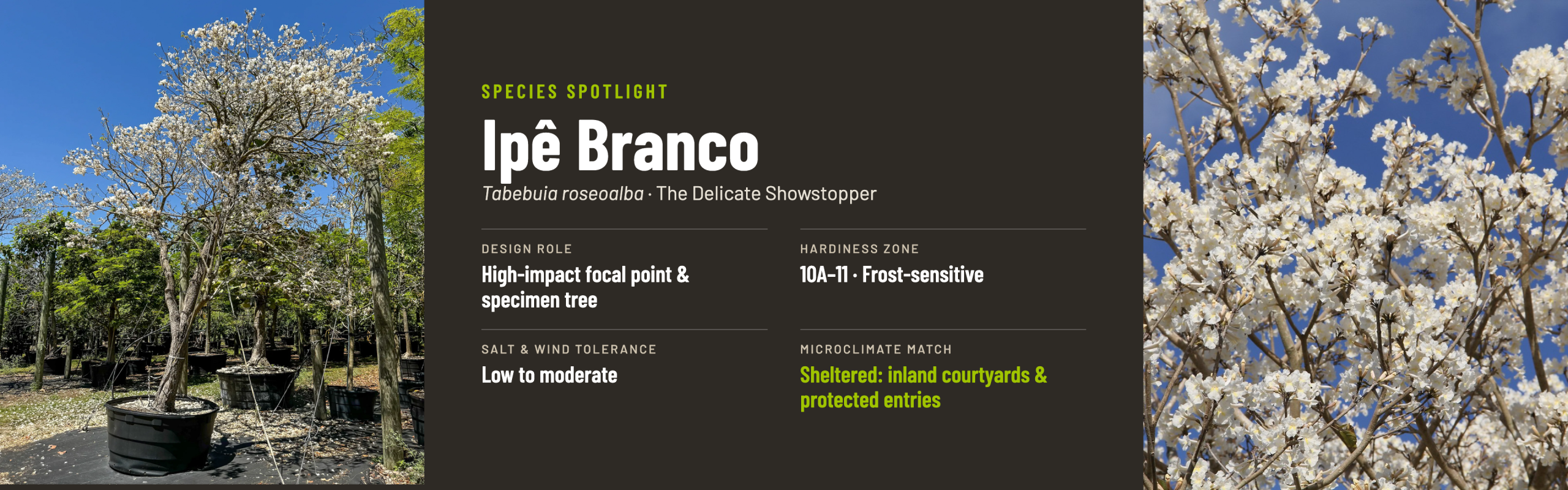
While its visual impact is unparalleled, specifying the Ipê Branco successfully requires strict adherence to its biological limits.
- Design Role: High-impact focal point, specimen tree, and luxury residential anchor.
- Hardiness Zone: 10A–11. It is highly frost-sensitive.
- Salt & Wind Tolerance: Low to moderate. The canopy can suffer in direct, aggressive coastal wind, and the foliage is sensitive to aerosolized salt spray.
- The Microclimate Match: This white tabebuia demands a sheltered microclimate. It thrives in inland estate courtyards, wind-shielded commercial entryways, and architectural spaces where surrounding structures buffer cold winds and salt exposure. Specifying an Ipê Branco in an exposed coastal streetscape is a recipe for long-term stress, but placing it in a protected, well-draining thermal pocket yields an unmatched aesthetic return.
Species Spotlight: Tabebuia bahamensis (Bahama White)
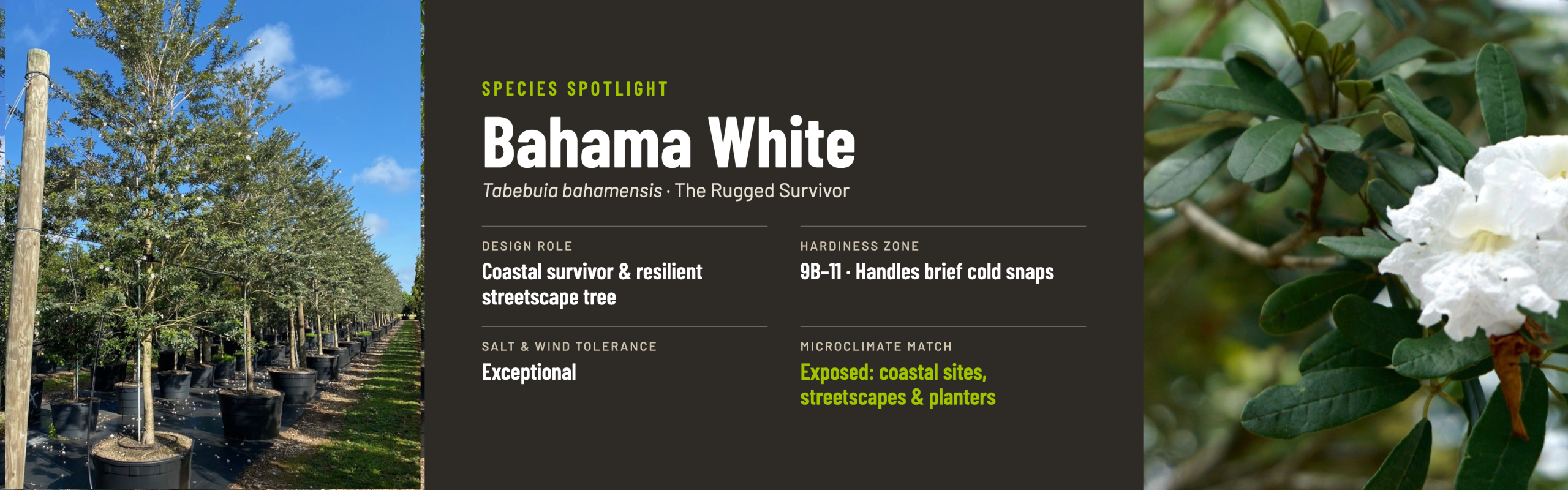
If the Ipê Branco is the delicate showstopper, Tabebuia bahamensis is the rugged survivor. Native to the harsh coastal environments of the Bahamas and South Florida, this species is biologically engineered for exposure. It offers a more subtle, continuous display of pale pink to pure white trumpet flowers against a smaller, highly adaptable canopy.
- Design Role: Coastal survivor, resilient streetscape component, and xeriscaping anchor.
- Hardiness Zone: 9B–11. It demonstrates higher adaptability to brief cold snaps compared to its South American cousins.
- Salt & Wind Tolerance: Exceptional. It is unfazed by direct salt spray and highly resilient in hurricane-prone wind corridors.
- The Microclimate Match: This is the ultimate sustainable choice for punishing urban and coastal microclimates. It excels in poor, rocky, or sandy soils where other tropical ornamentals stunt or fail. Landscape architects should specify T. bahamensis for highly exposed coastal properties, municipal streetscapes, and elevated planters with rapid drainage and intense thermal loading.
By contrasting these two species, the value of microclimate-driven specification becomes clear:
- T. roseoalba is the scalpel for precision architectural design,
- T. bahamensis is the multi-tool for broad, resilient urban forestry.
How to Use Water Management to Protect White Tabebuia from Cold Stress?
While both the Ipê Branco and Bahama White are prized for their extreme drought tolerance once established—making them ideal candidates for navigating strict municipal water restrictions—water remains one of your most effective tools for managing climate stress.
As detailed in our recent cold front management guide, proper soil moisture is critical during unexpected freezes, especially for sensitive tropical ornamentals like T. roseoalba. Dry soil significantly increases the risk of cold injury. Implementing a pre-freeze deep watering strategy at the floor level one to two days before a temperature drop increases soil heat retention. This protects the root system and stabilizes the lower trunk temperature through natural evaporation, providing a critical buffer against frost without oversaturating the foliage.
Specifying White Tabebuia the Right Way – A Smarter Approach to Sustainable Design
The demand for striking, architectural blooming trees is a constant in high-end design, but our new climate reality demands we specify them smarter. By shifting from an aesthetic-first approach to microclimate-driven specification, landscape architects can deliver the dramatic visual impact of white Tabebuias while fulfilling the mandate for sustainable, climate-resilient design.
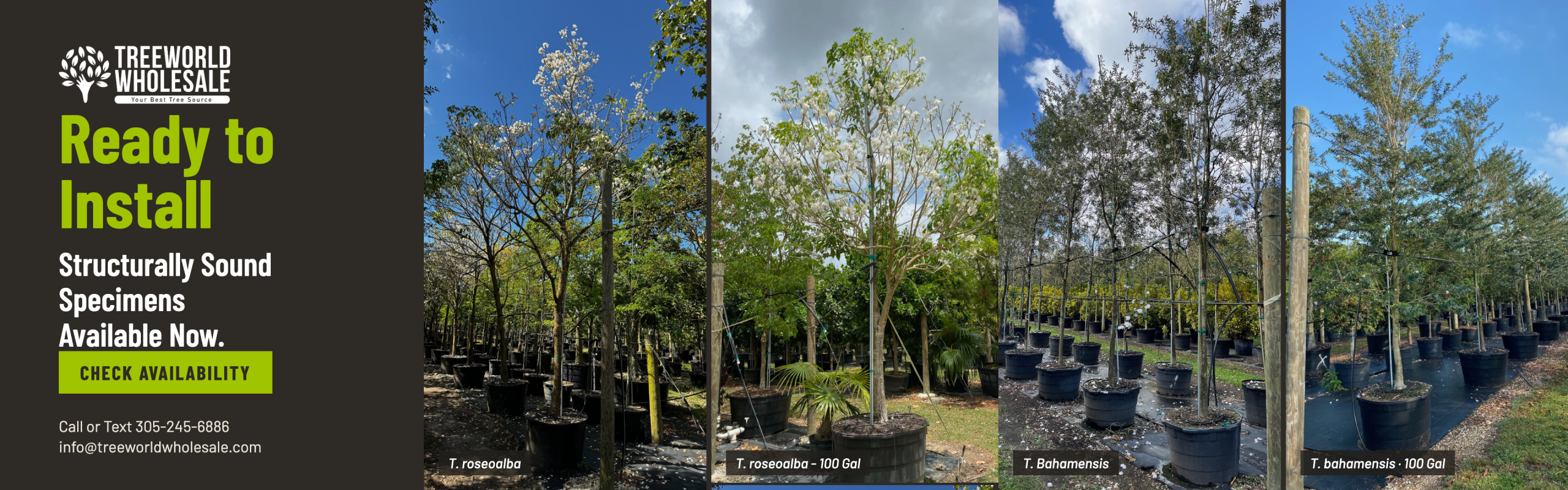
At TreeWorld Wholesale, we provide not just the inventory, but the horticultural know-how required to ensure your site plan thrives. Ready to source resilient ornamentals for your next major project? Contact us today to check our current Tabebuia specifications and availability.
Call or Text: 305-245-6886
Email: info@treeworldwholesale.com
Visit Us: Schedule an appointment to explore our inventory in Homestead and build a climate-resilient plant palette.
Frequently Asked Questions About White Tabebuia Trees in Florida
What is the difference between Tabebuia roseoalba and Tabebuia bahamensis?
Both produce white flowers, but they suit very different sites. T. roseoalba (Ipê Branco) is a high-impact showstopper for sheltered inland locations — frost-sensitive with low to moderate salt tolerance. T. bahamensis (Bahama White) is built for coastal and urban exposure — exceptional salt and wind tolerance, and more cold-hardy down to Zone 9B.
Where should I plant a white Tabebuia in Florida?
It depends on the species. Plant T. roseoalba in protected courtyards, wind-shielded commercial entries, and inland residential settings. Plant T. bahamensis in exposed coastal properties, municipal streetscapes, elevated planters, and sites with poor or sandy soil.
Are white Tabebuia trees drought-tolerant?
Yes — once established, both species are highly drought-tolerant and well-suited to Florida’s water restrictions. New plantings need consistent irrigation for the first few months while roots establish.
How do I protect white Tabebuia from cold damage in Florida?
For frost-sensitive T. roseoalba, deep water the soil 1–2 days before a predicted cold snap. Moist soil retains heat, stabilises root zone temperature, and provides a natural buffer against frost damage without oversaturating the foliage.
Can white Tabebuia be used in coastal landscaping?
- bahamensis absolutely — it’s native to the Bahamas and South Florida coastline and handles direct salt spray and hurricane-force wind corridors. T. roseoalba is not recommended for exposed coastal sites.
Where can I buy white Tabebuia trees in Florida?
Treeworld Wholesale in Homestead grows both T. roseoalba and T. bahamensis in landscape-ready sizes including 100-gallon specimens. Contact them for current availability and specifications.