
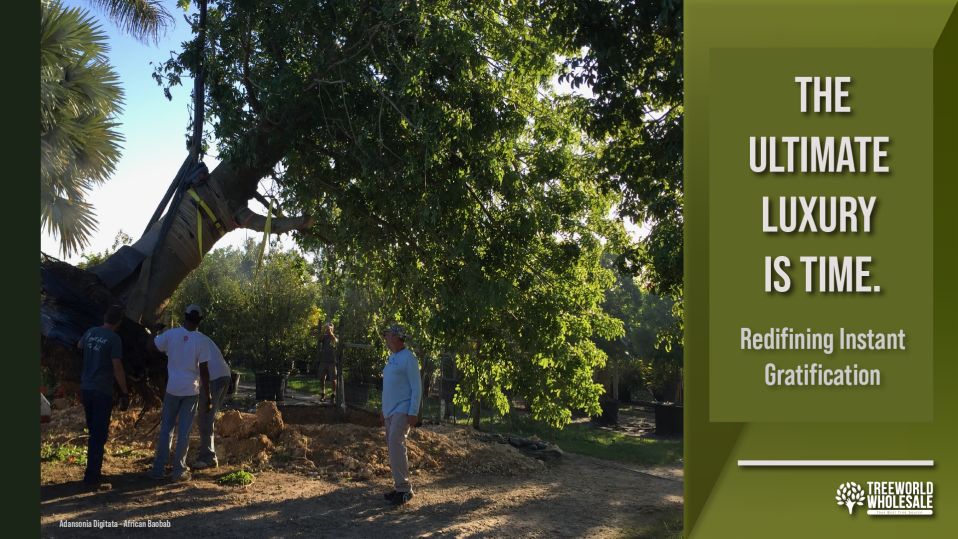
Container-grown specimens—the market for fully grown trees has never been hotter. From the growing side, the story reads a little differently.
The New York Times recently reported on what it called the latest wealth flex: big trees. Landscape architects in Palm Beach installing a matched pair of banyans at $250,000 apiece. An African baobab bought for half a million dollars. More than a hundred mature American hollies trucked into a Newport estate to form a privacy screen, at a cost well past a million. Fifty-foot specimens lifted onto flatbeds and moved down highways that had to be closed to let them pass.
The reporting is accurate and the trend is real. We see it in the projects that cross our desk. But read from Homestead, from inside the fields where trees like these are grown, one part of the story goes untold. Every tree in that article represents time that somebody spent. The buyer didn’t spend it. Somebody did. We did.
The market wants time it didn’t spend
What clients are buying isn’t really size. It’s age, and it’s time. They are buying the look of a landscape that appears to have been there for fifty years, delivered in a single season. “Why wait for a tree to grow if you can get something larger today?” one Southampton landscape architect told the Times. That impatience isn’t new; the piece traces it back to Capability Brown in the eighteenth century, reshaping English estates for owners who wouldn’t wait thirty years for an oak. What’s new is the scale, and the budgets.
For those of us who grow trees, the most telling line in the article came from another nurseryman: “We are growing a luxury here. We are not growing a necessity.”
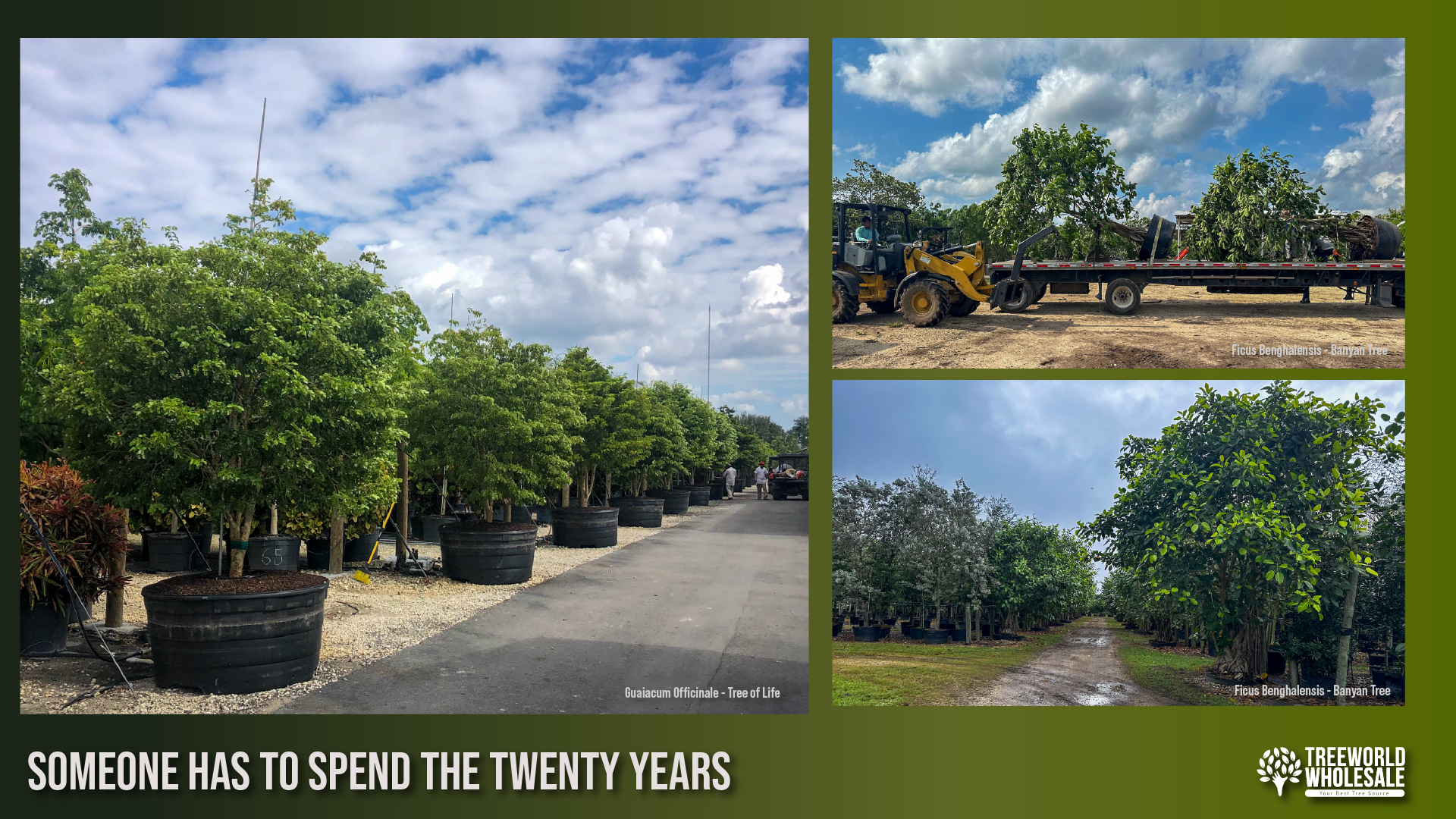
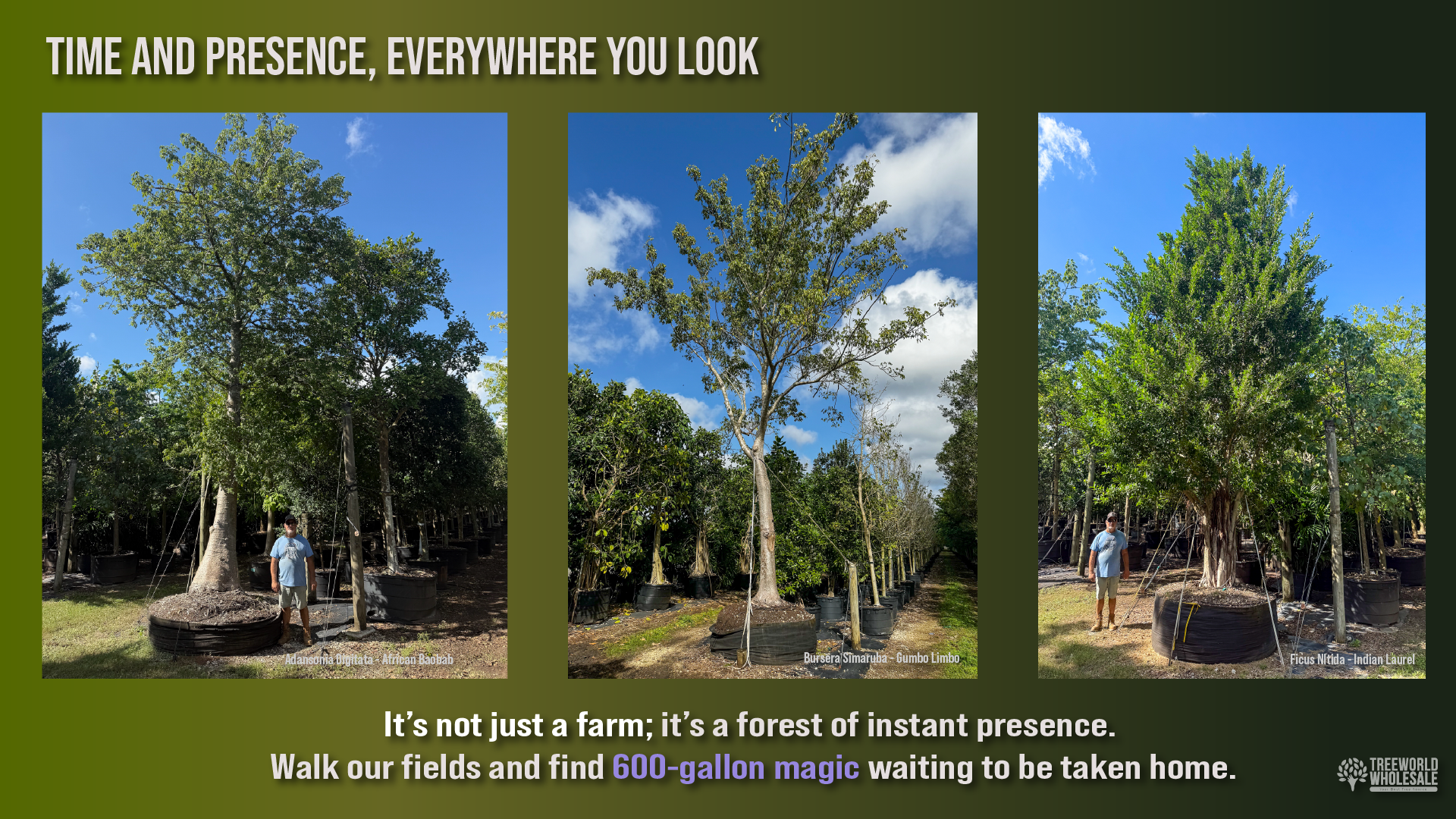
He’s right. But it’s worth being precise about what the luxury actually is. It isn’t the trunk diameter. It’s the twenty years already inside it. When a designer finds a 600-gallon gumbo limbo standing ready in our fields, the honest description of that container-grown specimen is two decades of somebody else’s patience.
Someone has to spend the twenty years
A 600-gallon tree does not begin as a 600-gallon tree. It begins small, and it moves up through container sizes over a decade or more. Repotted, root-pruned, staked, irrigated and inspected through every hurricane season in between. It occupies the ground the whole time. It costs money every year it isn’t sold.
That is the part of the supply chain that’s invisible from the design side, and it’s the reason lead times and pricing on specimen material work the way they do. A nursery cannot respond to a spike in demand for mature trees. The only trees available at that size in 2026 are the ones somebody planted in 2006 and kept alive since. Inventory in the ground is the product. There is no way to accelerate it, and no way to catch up.
So when a designer walks our fields and finds a 600-gallon gumbo limbo standing there, ready, the honest description of what’s for sale is two decades of somebody else’s patience.
A root system is either intact or it isn’t
Here is where the difference between one big tree and another stops being philosophical.
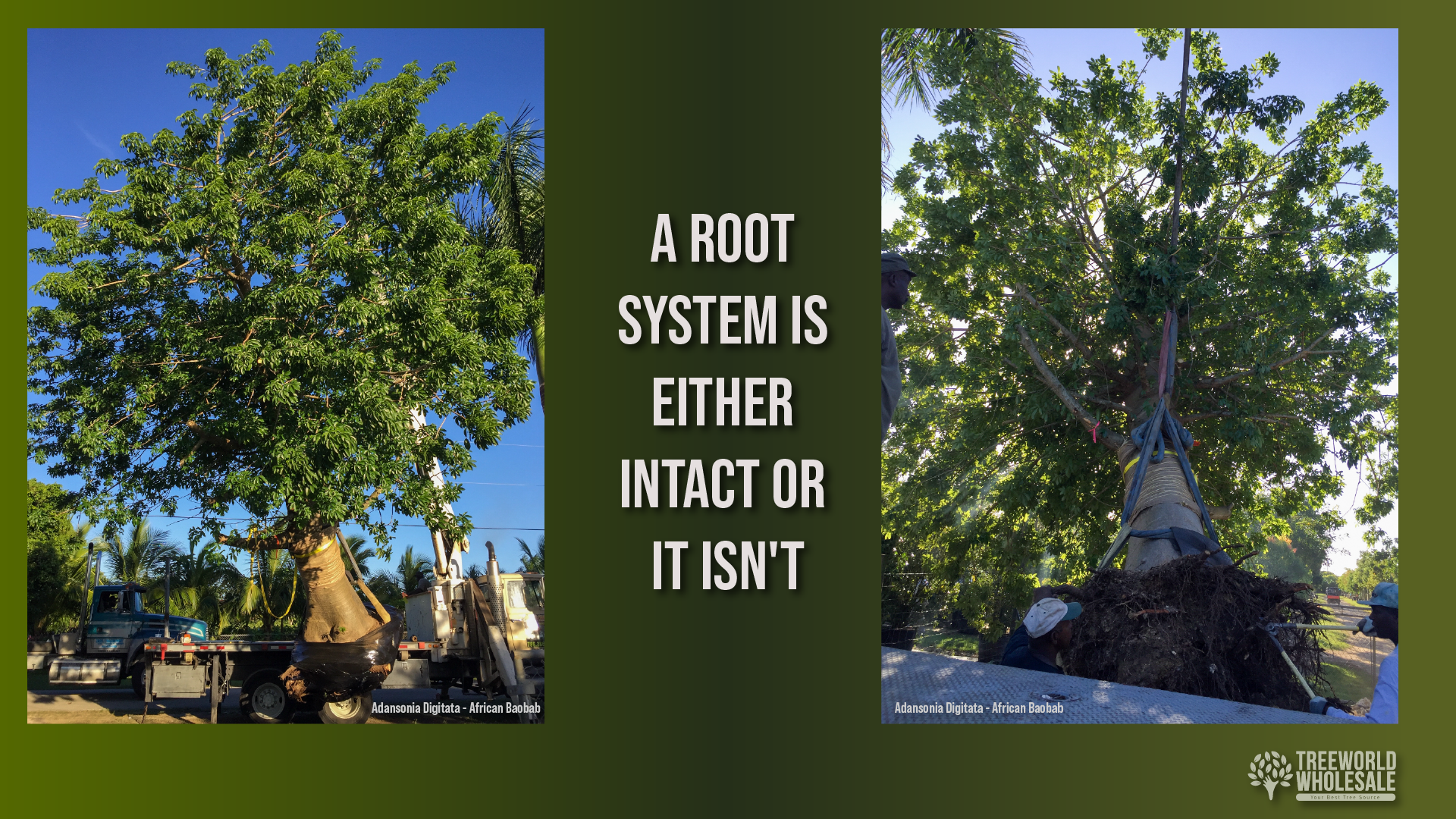
Most of the giants described in the Times are field-grown. They spend their lives in open ground and are harvested when sold. Dug with a hydraulic spade or by hand, the root ball wrapped and drum-laced, the rest of the root system left behind in the field. That severed portion is substantial. What arrives on site is a full-sized canopy supported by a fraction of the roots that were feeding it a week earlier, which is why transplanted field material goes into shock and why arborists still use the rough guideline of a year of recovery for every inch of trunk caliper. A large field-dug specimen can spend several years simply re-growing what it lost, looking thin and struggling while it does.
Every tree we cultivate is a container-grown specimen from start to finish. The root system that supported the tree yesterday is the same one that goes on the truck today. Nothing is cut at harvest, because there is no harvest, only a move. Those years of upcanning and root pruning are what make it possible: they build a dense, contained root mass instead of the circling roots that plague poorly managed container stock, so a tree of real size can be relocated and planted without ever being wounded.
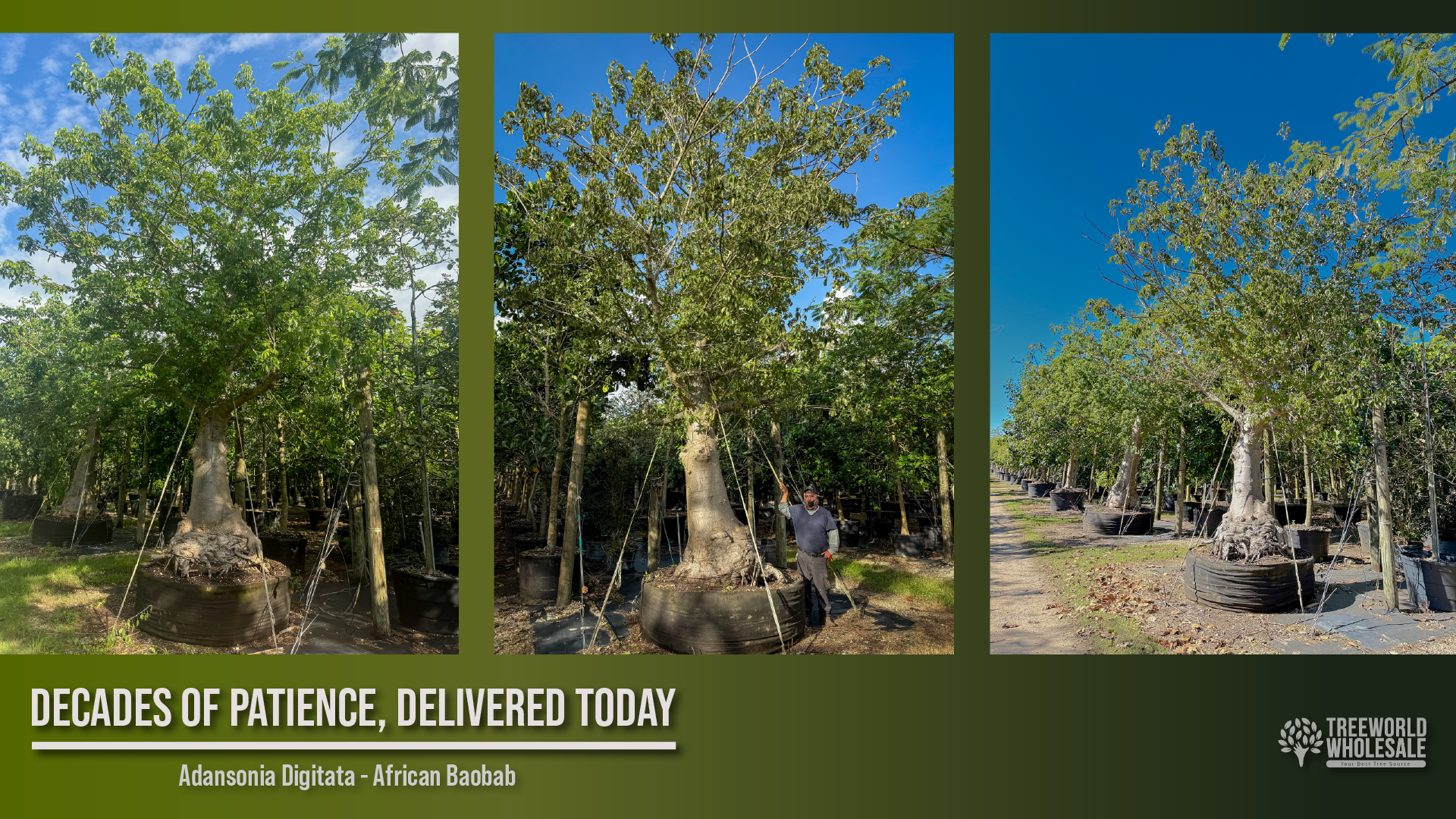
The practical consequence for a designer is establishment. A container-grown specimen begins putting energy into new growth almost immediately, rather than spending three seasons rebuilding itself. On a project where the client is paying for a finished landscape on handover day, that distinction is the entire investment.
It also means the tree is acclimated to the climate it’s going into. A baobab grown in South Florida is not an import and a gamble.
Our trees are grown, not collected
There’s a shadow in the Times piece that it doesn’t quite resolve. It notes that during the Gilded Age, the robber barons “ransacked virgin forests” for ornaments to decorate their estates. The language throughout is extractive. Trees wrenched from the earth, uprooted, taken.
Nothing in our fields was taken from anywhere. It was grown, from seed, on a farm in Homestead, by people who have been doing it for decades.
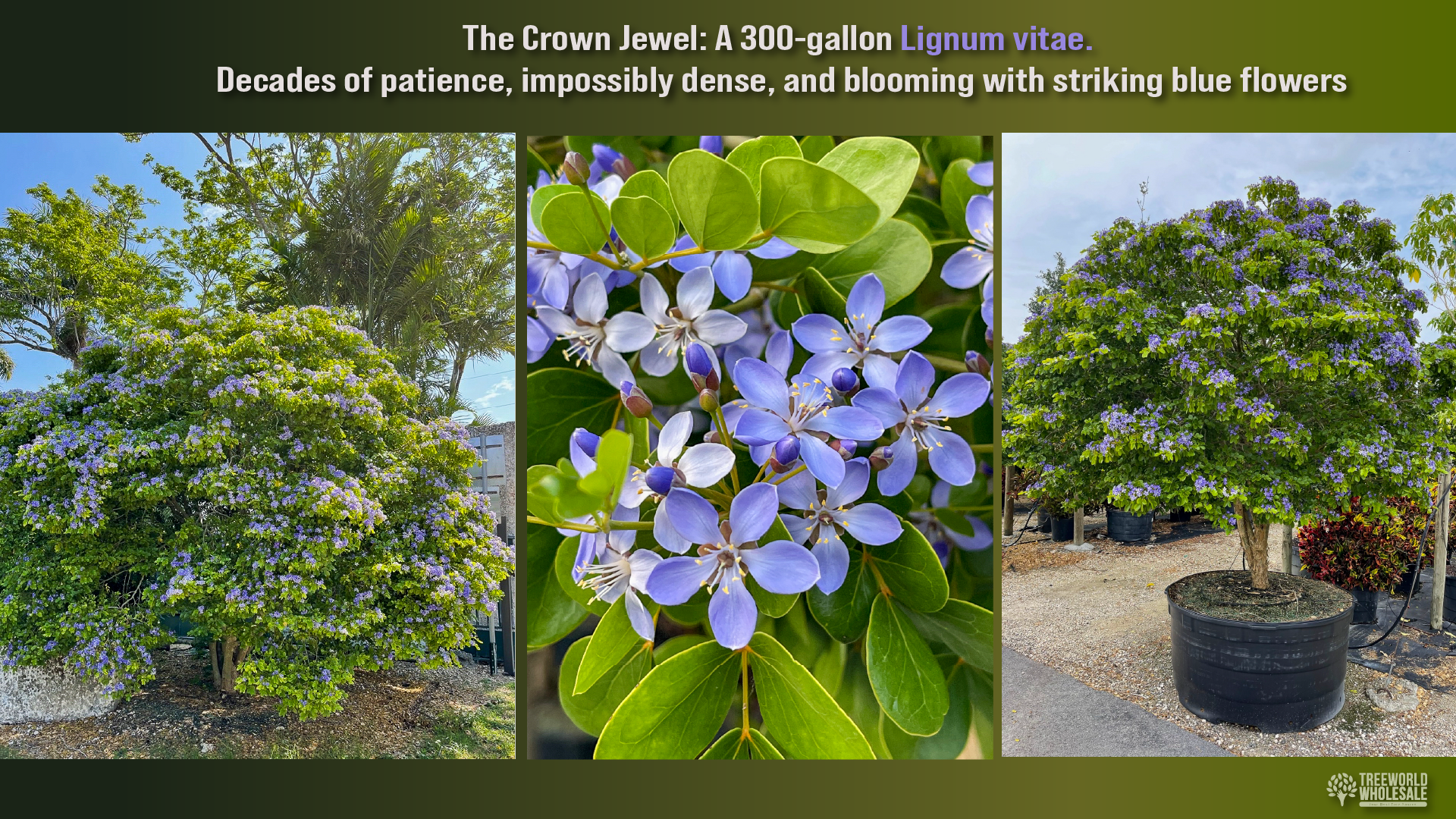
On common species that distinction is a matter of taste. On rare ones it is the whole matter. Lignum vitae — Guaiacum officinale, the Tree of Life — is listed as Endangered on the IUCN Red List and regulated under CITES Appendix II. It is also one of the slowest-growing trees on earth and the source of one of the densest woods ever put to use. A specimen of any real size is a genuine rarity. The only ethical way for one to appear in a private landscape is for a nursery to have propagated and grown it, which is exactly what ours are: nursery-grown, documented, and never removed from a wild population.
That is something a designer can tell a client, and it justifies the specimen on grounds other than price.
What the fields actually hold
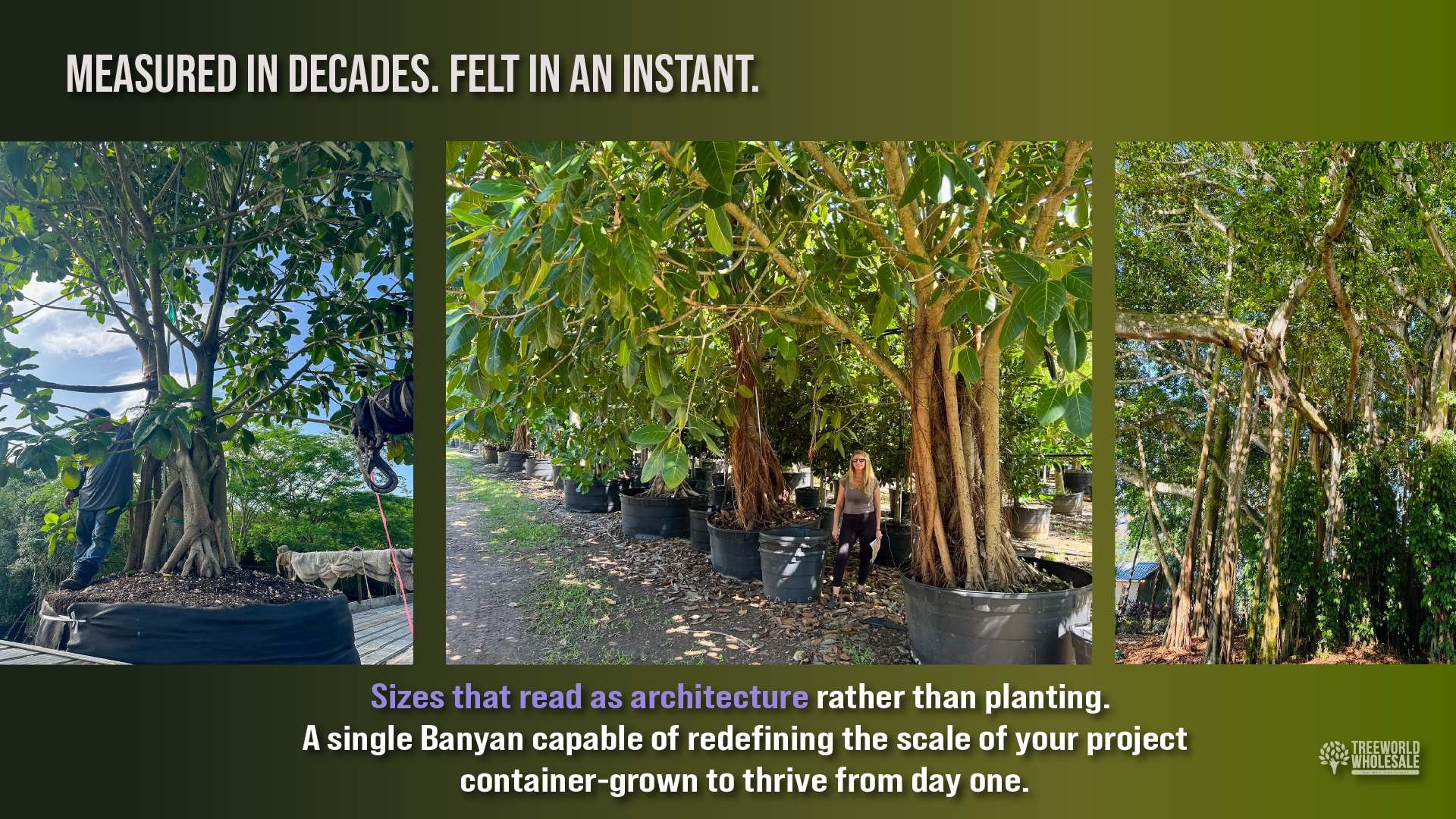
For a landscape architect, a day here is a strange kind of shopping trip. Native gumbo limbo at 600 gallons, with the copper bark and the sculptural branching that no substitute reproduces. The paradigm-breakers from the article — African baobab, Ficus benghalensis — growing in the same South Florida soil where they’ll be planted, no international shipment required. Rain trees, ceibas, royal poincianas at sizes that read as architecture rather than planting.
And then, smaller but harder to find, the crown jewel: Lignum vitae at 300 gallons. Blue flowers, compact and slow and impossibly dense. Given how slowly it grows, a 300-gallon Lignum vitae represents more accumulated time than a 600-gallon specimen of almost anything else on the property.
Which is, in the end, the correct way to read the whole trend. The Times called it a wealth flex. From this side of the transaction it looks like something quieter: decades of patience, grown deliberately, available by appointment.
Treeworld Wholesale grows more than 300 species of tropical and subtropical trees in containers from 25 to 600 gallons in Homestead, Florida. To schedule a visit or request availability on a container-grown specimen for your next municipal or private design project, contact us at info@treeworldwholesale.com or 305-245-6886.